Binance’s $6.3 Billion Crypto Hack: Who Is Legally Responsible?
The reported cyberattack against Binance on 29 October 2026 has raised serious concerns about cryptocurrency exchange security, digital asset custody and the legal responsibilities of virtual asset service providers (VASPs).
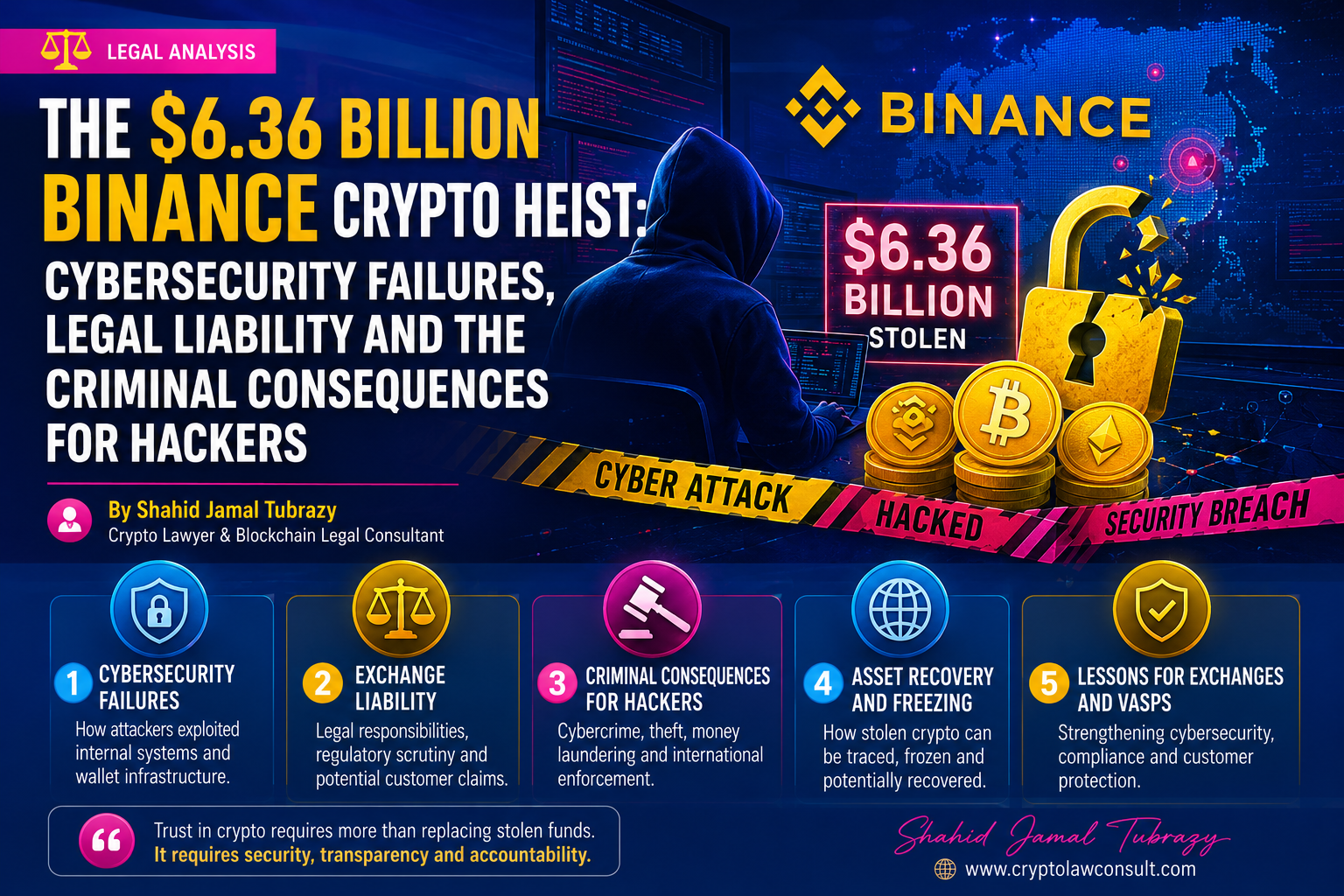
According to blockchain intelligence firm TRM Labs, approximately $6.36 billion in digital assets was transferred from Binance wallets across ten blockchain networks, with most transfers reportedly occurring within approximately 20 minutes. TRM attributed the operation to TraderTraitor, a North Korean-linked hacking group.
The Federal Bureau of Investigation (FBI) subsequently confirmed on 31 October 2026 that North Korea was responsible for the theft of more than $6 billion in virtual assets from Binance and identified the activity as TraderTraitor.
Sources:
- TRM Labs – North Korea Steals USD 6.36 Billion From Binance
- FBI – North Korea Responsible for $6 Billion+ Binance Attack
Binance confirmed unauthorized withdrawals from its hot-wallet infrastructure and initially reported that its investigation suggested a compromised DevOps engineer’s laptop may have been involved. It also stated that it had found no evidence of a wallet private-key leak.
Binance committed to covering the financial impact through its Secure Asset Fund for Users (SAFU) and corporate funds. Its subsequent updates reported that approximately 90% of affected assets had been replenished by 31 October 2026.
These developments raise important questions: How could such a large-scale attack occur? What legal responsibilities does a cryptocurrency exchange have when customer assets are compromised? And what criminal consequences may follow for those responsible?
This incident is not simply a cybersecurity story. It is a major case study in digital asset custody, financial regulation, international cybercrime and legal accountability.
1. Cybersecurity Implications: How Could Such an Attack Happen?
Initial reporting indicates that the incident involved compromised Binance hot-wallet infrastructure. Binance’s initial investigation referred to a potentially compromised employee device, while TRM’s blockchain analysis identified transaction patterns pointing towards a compromise of hot-wallet signing infrastructure.
It is important to distinguish between a confirmed security incident and the precise technical attack method. The full technical investigation and post-incident findings are necessary before drawing definitive conclusions about the vulnerabilities involved.
Nevertheless, the incident highlights several important cybersecurity requirements.
A. Multi-signature wallet security
Cryptocurrency exchanges should implement strong multi-signature authorization and independent approval mechanisms for high-value wallet transactions.
No single compromised employee account or device should be sufficient to authorize significant transfers without additional verification.
B. Hardware Security Modules (HSMs)
Private keys should be protected through appropriately configured hardware security modules or equivalent secure key-management infrastructure.
Access to signing operations should be restricted, monitored and independently verified.
C. Zero-trust security architecture
Exchanges should not automatically trust employees, devices or internal network connections.
Sensitive requests should undergo authentication, authorization and risk assessment, regardless of whether they originate from inside or outside the organization’s network.
D. Employee access and endpoint protection
Privileged employee devices should be protected through endpoint detection and response, multi-factor authentication, restricted administrative privileges and continuous security monitoring.
Employee access should be limited according to operational necessity.
E. Real-time transaction monitoring
Large or unusual withdrawals should trigger automated risk controls, transaction limits, additional approvals and, where technically possible, temporary suspension mechanisms.
F. Incident response and forensic preservation
Following a suspected breach, an exchange should preserve system logs, endpoint records, transaction data, authentication histories and relevant communications.
These records may become essential evidence in criminal investigations, regulatory proceedings and civil litigation.
The central lesson is that blockchain security is not limited to protecting private keys. It also requires securing employees, applications, signing systems, administrative infrastructure and internal authorization processes.
2. Legal Responsibilities of Binance: Can the Exchange Be Held Liable?
A major legal question is whether Binance could face regulatory, contractual or civil liability arising from the incident.
The answer depends on the relevant Binance legal entity, applicable jurisdiction, custody arrangements, customer agreements, regulatory obligations and findings of the technical investigation.
A successful cyberattack does not automatically establish negligence or legal liability on the part of an exchange. However, the incident may lead regulators and customers to examine whether the exchange maintained appropriate safeguards.
A. Duty to protect customer assets
Where an exchange holds or controls customer digital assets, its contractual and regulatory obligations may include safeguarding those assets, maintaining appropriate custody arrangements and protecting customers against unauthorized access.
If an investigation establishes inadequate access controls, defective wallet authorization procedures or unreasonable security practices, the exchange’s compliance with applicable obligations may be questioned.
B. Regulatory investigation and enforcement
Depending on the jurisdictions in which the relevant Binance entities operate, regulators may investigate:
- Whether appropriate cybersecurity controls were maintained.
- Whether custody and private-key management systems met applicable standards.
- Whether incident-reporting obligations were fulfilled.
- Whether customer assets were adequately segregated and protected.
- Whether internal risk-management and governance systems were effective.
Where regulatory violations are established, possible consequences may include financial penalties, enhanced supervision, remediation requirements or restrictions on particular activities.
C. Customer claims and contractual liability
Affected customers may examine their contractual rights and available legal remedies.
Potential claims could involve breach of contract, failure to exercise reasonable care, misrepresentation or breach of statutory duties, where recognized under the relevant law.
However, customers would need to establish the necessary legal elements, including duty, breach, causation and loss. The exchange’s terms of service, custody arrangements and applicable limitations of liability would also require examination.
D. Cybersecurity governance and internal accountability
The incident may lead to scrutiny of management oversight, employee access policies, security audits and internal controls.
If an employee device was compromised, that fact alone does not establish employee misconduct. The investigation must determine whether the compromise resulted from phishing, malware, credential theft, insider assistance or another attack vector.
E. Financial responsibility and customer protection
Binance’s commitment to replace the affected assets is a significant financial response.
However, financial reimbursement and legal compliance are separate questions. Replacing customer assets does not automatically resolve potential regulatory breaches, reporting obligations or questions concerning the adequacy of security controls.
A useful distinction is that financial remediation may protect customers from direct losses, but it does not necessarily eliminate regulatory or legal accountability.
Relevant source: Binance – Security Incident Updates.
3. Legal Consequences for the Hackers: Cybercrime, Theft and International Enforcement
The legal position of individuals responsible for unauthorized cryptocurrency transfers is substantially different from that of the affected exchange.
If investigators establish that the attackers intentionally accessed systems without authorization, manipulated wallet infrastructure and transferred digital assets for their own benefit, their conduct could constitute several serious criminal offences.
A. Unauthorized computer access
Unauthorized access to protected computer systems may constitute a criminal offence under the laws of the jurisdiction where the conduct occurred or where the affected systems are legally protected.
In the United States, the Computer Fraud and Abuse Act (CFAA), 18 U.S.C. § 1030, may apply to qualifying unauthorized computer access, damage to protected computers and related conduct.
Official legislation: United States Code – 18 U.S.C. § 1030.
B. Cryptocurrency theft and fraud
Unauthorized transfers of digital assets may give rise to theft, fraud, wire-fraud or other financial-crime charges, depending on the facts and applicable law.
In the United States, prosecutors may examine:
- 18 U.S.C. § 1343 – Wire fraud.
- 18 U.S.C. § 1030 – Computer fraud and abuse.
- 18 U.S.C. § 1956 – Money laundering.
- 18 U.S.C. § 1957 – Certain monetary transactions in criminally derived property.
These offences have different legal elements. Their application depends on jurisdiction, evidence, intent and the conduct of each accused person.
Official legislation: 18 U.S.C. § 1343 – Wire Fraud.
C. Money laundering and movement of stolen assets
Moving stolen cryptocurrency through multiple wallets, exchanges, decentralized finance protocols or other services may attract additional criminal scrutiny.
Investigators can examine transaction histories, wallet relationships, exchange deposits, liquidity movements and attempts to conceal the origin or ownership of assets.
The use of blockchain technology does not make criminal proceeds legally untraceable. Public blockchain records can provide valuable investigative evidence, although attribution to particular individuals requires additional evidence.
D. International sanctions and state-linked cybercrime
The FBI’s attribution of the Binance theft to TraderTraitor raises additional international legal concerns.
Where a cyber operation is linked to a state-sponsored group, authorities may examine the involvement of individuals, financial intermediaries and entities associated with the operation.
Depending on the evidence, relevant authorities may consider sanctions, asset-freezing measures, criminal prosecutions and international cooperation.
However, attribution to a state-linked hacking group does not automatically establish the criminal responsibility of every individual associated with that state. Individual criminal responsibility must be established through admissible evidence and applicable legal procedures.
E. Extradition and international cooperation
Cybercrime investigations involving multiple countries require cooperation between law-enforcement agencies, prosecutors, financial intelligence units and cryptocurrency businesses.
Authorities may seek:
- Preservation of exchange and blockchain records.
- Identification of wallet controllers.
- Freezing of suspected criminal proceeds.
- Mutual legal assistance.
- Extradition where legal requirements are satisfied.
- Criminal prosecution in a jurisdiction with lawful jurisdiction over the conduct.
The practical difficulty is that suspects may operate from jurisdictions where extradition is unavailable, politically complicated or difficult to enforce.
4. Can Stolen Cryptocurrency Be Frozen or Recovered?
One of the most important aspects of cryptocurrency investigations is the possibility of identifying and freezing assets before they are converted, withdrawn or transferred beyond practical recovery.
The Binance incident demonstrates the importance of rapid cooperation between exchanges, blockchain intelligence firms, law-enforcement agencies and token issuers.
A. Stablecoin freezing mechanisms
Certain centralized stablecoin issuers have technical capabilities to freeze tokens at the contract level when legally and operationally justified.
This can assist in preventing further movement of suspected stolen funds.
However, not all digital assets have a centralized issuer capable of freezing individual wallets.
B. Centralized exchange cooperation
Centralized exchanges may restrict accounts receiving suspected stolen assets, subject to their legal obligations, internal policies and applicable orders.
Exchange records may also assist in identifying account holders and tracing potential conversion or withdrawal activity.
C. Blockchain intelligence and transaction tracing
Blockchain intelligence firms can assist investigators by tracing transactions across multiple networks and identifying wallet clusters and potential off-ramps.
In the Binance incident, TRM Labs published its analysis and the FBI subsequently published addresses associated with the operation.
Relevant resources:
D. Important factors affecting recovery
Recovery depends on several factors:
- Speed of detection and reporting.
- Availability of reliable blockchain transaction evidence.
- Identification of exchanges and service providers receiving the assets.
- Cooperation from token issuers and relevant platforms.
- Availability of lawful freezing and confiscation orders.
- Successful identification of those controlling the funds.
There is no guarantee that all stolen cryptocurrency can be recovered. Some assets may be moved into decentralized or non-freezable systems, making recovery more difficult.
5. Lessons for Cryptocurrency Exchanges and VASPs
This incident should encourage cryptocurrency exchanges, VASPs, custodians and digital financial institutions to reconsider their cybersecurity frameworks.
A robust security and compliance programme should include:
- Independent cybersecurity audits.
- Secure private-key custody and management.
- Multi-signature and multi-party authorization.
- Segregation of operational and customer assets.
- Employee background checks and privileged-access monitoring.
- Continuous threat detection and incident response.
- AML/CFT controls and suspicious transaction monitoring.
- Documented business continuity and disaster recovery procedures.
- Periodic penetration testing and vulnerability assessments.
- Transparent customer communication during security incidents.
For VASPs, cybersecurity should not be treated merely as an IT expense. It is a fundamental component of operational risk management, legal compliance and customer protection.
Regulatory frameworks increasingly require financial and virtual-asset businesses to demonstrate appropriate governance, risk management and safeguarding arrangements.
Further reading:
6. Conclusion: Financial Reimbursement Is Not a Substitute for Cybersecurity Accountability
The reported $6.36 billion Binance incident is a serious reminder that even major cryptocurrency platforms remain vulnerable to sophisticated cyber operations.
The legal consequences may extend beyond the immediate financial loss. They may include regulatory investigations, customer claims, international criminal proceedings, sanctions-related action and greater scrutiny of digital asset custody standards.
For Binance, the central legal questions concern the adequacy of its security arrangements, the fulfilment of its contractual and regulatory obligations, and the effectiveness of its response.
For the attackers, unauthorized access, theft, fraud and money laundering may carry substantial criminal consequences if established through lawful investigation and prosecution.
The broader lesson is clear: trust in the cryptocurrency industry cannot depend solely on the ability of an exchange to replace stolen funds. It must also depend on effective cybersecurity, responsible custody, transparent governance and enforceable legal accountability.
About the Author
Shahid Jamal Tubrazy is a Crypto Lawyer and Blockchain Legal Consultant, advising on cryptocurrency regulation, blockchain businesses, virtual asset compliance, digital asset disputes and crypto-related legal matters.
Website: https://cryptolawconsult.com/
LinkedIn: https://www.linkedin.com/in/shahidtubrazy/
Disclaimer: This article is for general legal and educational purposes. It does not constitute legal advice or a determination of liability. Incident details, attribution and recovery figures may evolve as investigations continue. Legal consequences depend on the applicable jurisdiction and evidence.