
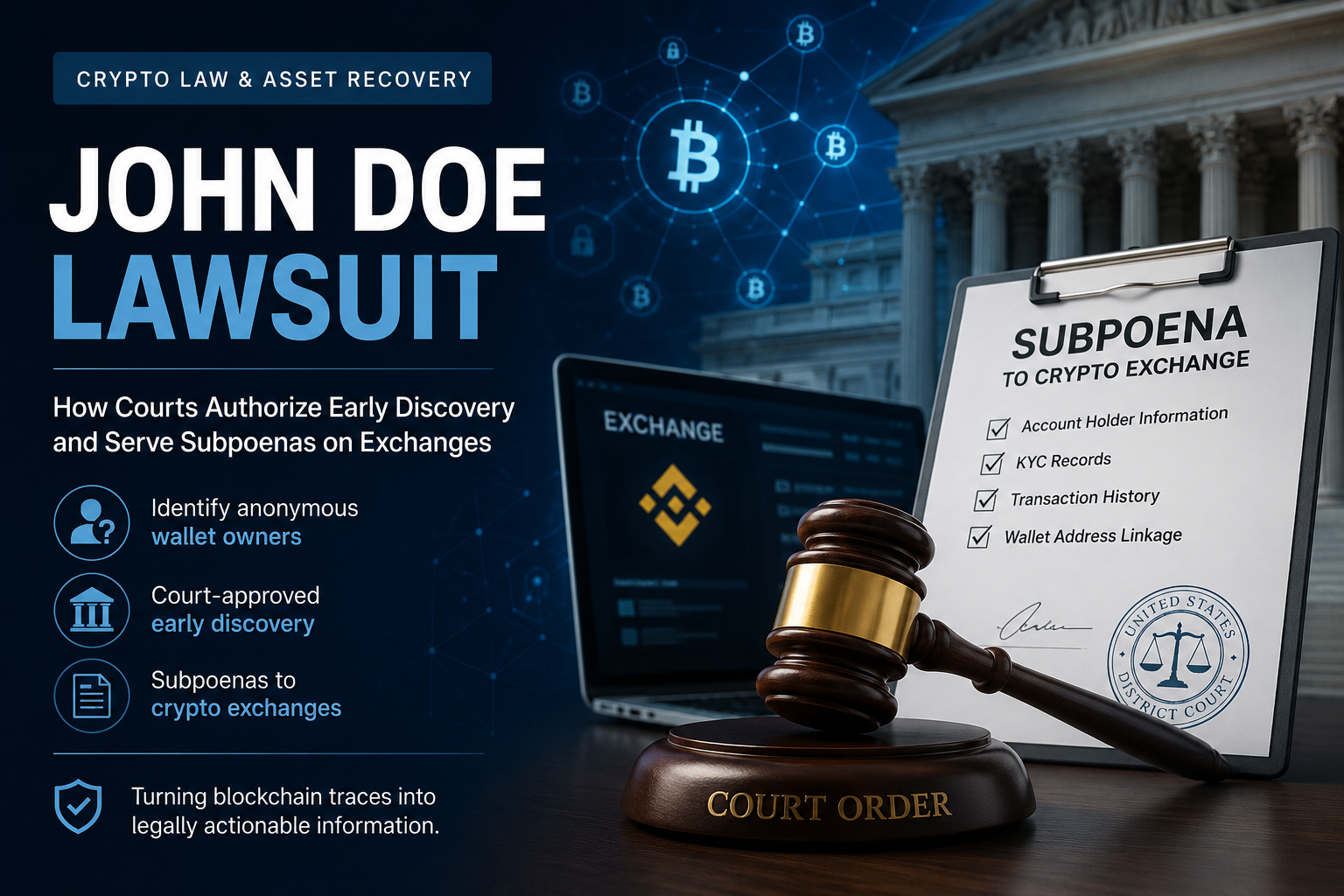
What Is a John Doe Lawsuit in Crypto Cases? How Courts Authorise Early Discovery and Subpoenas to Cryptocurrency Exchanges
One of the biggest challenges in cryptocurrency fraud and asset-recovery cases is identifying the person behind a blockchain wallet address. A victim may have transaction IDs, wallet addresses, screenshots and evidence of transfers, but still have no reliable information about the person who received or controls the stolen cryptocurrency.
In certain circumstances, a John Doe lawsuit can provide a legal route to identifying an unknown defendant. In the United States, courts may allow a claimant to seek early discovery and serve subpoenas on cryptocurrency exchanges or other third parties that may hold identifying information.
This procedure can help turn an anonymous blockchain address into a legally identifiable person or entity.
1. What is a John Doe lawsuit?
A John Doe lawsuit is a legal action filed against a defendant whose true identity is unknown at the time proceedings begin.
Instead of naming the defendant’s actual name, the claimant identifies that person as “John Doe” or “John Doe 1, John Doe 2” and so on.
In cryptocurrency disputes, this may happen when:
- Cryptocurrency is allegedly stolen through fraud, phishing or investment scams.
- The victim traces the assets to one or more wallet addresses.
- The wallet addresses appear to be connected to accounts at centralised cryptocurrency exchanges.
- The victim does not know the account holder’s legal name or contact details.
- The claimant needs court-authorised discovery to identify the responsible person.
A John Doe lawsuit does not automatically establish that the wallet owner committed fraud. The claimant must still establish the legal basis for the claims and prove the relevant facts.
2. Why does a claimant request early discovery?
Ordinarily, formal discovery in US federal civil litigation generally takes place after the parties’ Rule 26(f) conference. However, Federal Rule of Civil Procedure 26(d)(1) permits discovery before that conference when authorised by court order or agreement.
A claimant may therefore request expedited discovery to obtain limited identifying information before the ordinary discovery timetable begins.
In crypto cases, the request may be justified by the need to:
- Identify an unknown defendant.
- Determine which exchange account received the traced assets.
- Obtain account-holder details necessary for service of process.
- Preserve relevant account and transaction records.
- Support an application for appropriate interim relief, where legally justified.
The court does not grant early discovery automatically. The claimant must explain why it is necessary, identify the likely source of the information and show that the proposed requests are sufficiently specific and proportionate.
3. How does the court authorise subpoenas to cryptocurrency exchanges?
Under Federal Rule of Civil Procedure 45, a party may use a subpoena to request documents or information from a non-party, subject to the applicable procedural requirements.
For example, if blockchain tracing indicates that stolen cryptocurrency was transferred to a wallet associated with an exchange, the claimant may ask the court for permission to issue a subpoena to that exchange.
Depending on the court’s order and the evidence, the requested information may include:
- Account holder’s legal name.
- Residential or mailing address.
- Registered email address and telephone number.
- KYC identification records.
- Relevant account-opening information.
- Records linking a specified deposit address to an exchange account.
- Relevant transaction and account records.
The scope depends on the court’s authorisation. A subpoena should not be treated as unrestricted permission to obtain every record held by an exchange.
4. What have US courts decided in cryptocurrency cases?
Several decisions illustrate how this procedure can work.
Jacobo v. Doe (2022)
In Jacobo v. Doe, a US federal court authorised expedited discovery from several cryptocurrency exchanges to identify an unknown defendant. The court permitted subpoenas seeking specific identifying information, including the defendant’s legal name, street address, telephone number and email address. The decision demonstrates how blockchain destination addresses and supporting evidence can form the basis of a targeted discovery request. law.justia.com+1
Min Ji Goo Ji Goo Dyer v. John Does 1–10 (2024)
In this matter, the US District Court for the Northern District of California granted leave to serve third-party subpoenas on Binance and Bitcoin.com. The claimant had supplied evidence connecting two specified wallet addresses to the alleged scheme. The court found good cause for limited discovery to identify the relevant account holders. govinfo.gov
Ramirez v. Defendant 1 (2025)
In Ramirez, the claimant alleged that cryptocurrency had been stolen through a fraudulent application and transferred through unhosted wallets and exchange-hosted accounts. The claimant sought permission to subpoena Binance and HitBTC for information that could help identify the unknown defendants. law.justia.com
These decisions demonstrate that courts may permit targeted discovery in appropriate circumstances. They do not establish an automatic right to obtain exchange records in every crypto-fraud dispute.
5. What happens after the exchange receives the subpoena?
If a subpoena is properly authorised and served, the exchange may review the request and respond in accordance with the subpoena and applicable law.
Possible outcomes include:
- Identity disclosure: The exchange provides responsive account-holder information.
- Account linkage: Records may help establish whether a specified blockchain address is associated with an exchange account.
- Transaction evidence: Relevant records may assist in reconstructing the movement of funds.
- Objection or challenge: The exchange or affected account holder may object or seek to quash or modify the subpoena.
- Further proceedings: The claimant may seek to amend the complaint, serve the identified defendant or request further relief.
Importantly, identifying an exchange account holder does not by itself prove that the account holder was the scammer. Accounts may be controlled by nominees, compromised users or intermediaries. Additional evidence is often necessary.
6. Can a John Doe lawsuit help freeze stolen cryptocurrency?
Potentially, but identification and asset preservation are separate legal issues.
A claimant may seek a temporary restraining order, preliminary injunction or other appropriate relief, depending on the jurisdiction, facts and applicable legal standards.
Where there is credible evidence that assets may be transferred or dissipated, the claimant may explain the urgency to the court. However, a subpoena alone does not freeze cryptocurrency, and an order directed at an exchange may have practical limitations if the assets have already moved to an unhosted wallet or another platform.
7. Practical legal considerations for victims
A claimant considering this route should preserve and organise:
- Original transaction IDs (TXIDs).
- Sending and receiving wallet addresses.
- Blockchain explorer records.
- Exchange deposit-address information, where available.
- Communications with the suspected fraudsters.
- Payment receipts and bank-transfer records.
- Screenshots, website records and relevant account information.
- A tracing report explaining the connection between the stolen assets and the proposed subpoena recipients.
The legal application should identify the specific information sought, explain why each third party is likely to possess it and connect the requested information to the claims in the case.
Conclusion
A John Doe lawsuit can be an important procedural tool in cryptocurrency fraud litigation, particularly when the victim can trace stolen assets but cannot identify the person controlling the receiving account.
Court-authorised early discovery and properly framed Rule 45 subpoenas may help obtain KYC information and other relevant records from cryptocurrency exchanges. Nevertheless, the process requires a sound evidential foundation, compliance with procedural rules and careful attention to jurisdiction.
For victims, the central lesson is that blockchain tracing and legal proceedings can work together: tracing may identify where assets travelled, while court-supervised discovery may help establish who is behind the relevant exchange account.
Legal disclaimer: This article provides general legal information, not jurisdiction-specific legal advice. John Doe procedures, discovery standards, subpoena requirements and asset-freezing remedies vary by jurisdiction and case.
Short meta description
Learn how John Doe lawsuits, expedited discovery and court-authorised subpoenas help identify anonymous cryptocurrency wallet owners and investigate crypto fraud.
Website backlinks and legal references
These are useful authoritative or case-specific links to include within the article:
1. Federal Rule of Civil Procedure 26 — Early Discovery
https://www.law.cornell.edu/rules/frcp/rule_26
2. Federal Rule of Civil Procedure 45 — Subpoenas
https://www.law.cornell.edu/rules/frcp/rule_45
3. Jacobo v. Doe — Expedited Discovery from Cryptocurrency Exchanges
https://law.justia.com/cases/federal/district-courts/california/caedce/1%3A2022cv00672/411929/9/
4. Min Ji Goo Ji Goo Dyer v. John Does — Binance and Bitcoin.com Subpoenas
https://www.govinfo.gov/content/pkg/USCOURTS-cand-3_23-cv-01226/pdf/USCOURTS-cand-3_23-cv-01226-9.pdf
5. Ramirez v. Defendant 1 — Cryptocurrency Fraud and Exchange Discovery
https://law.justia.com/cases/federal/district-courts/louisiana/laedce/2%3A2025cv01576/274277/14/
6. Crypto Law Consult — Legal and Regulatory Services
https://cryptolawconsult.com/
About the Author
Shahid Jamal Tubrazy is a Crypto Lawyer and Blockchain Legal Consultant, advising on cryptocurrency regulation, blockchain businesses, virtual asset compliance, digital asset disputes and crypto-related legal matters.
Website: https://cryptolawconsult.com/
LinkedIn: https://www.linkedin.com/in/shahidtubrazy/
Disclaimer: This article is for general legal and educational purposes. It does not constitute legal advice or a determination of liability. Incident details, attribution and recovery figures may evolve as investigations continue. Legal consequences depend on the applicable jurisdiction and evidence.