Binance Withdrawal Restricted: Why Your Cryptocurrency Funds Are Frozen and How to Resolve It
Cryptocurrency users worldwide increasingly report difficulties withdrawing their digital assets from centralised exchanges. One particularly concerning situation occurs when a Binance user can log in, view their account balance and sometimes even convert one cryptocurrency into another, but cannot withdraw funds to an external wallet.
For affected users, the situation raises important questions:
- Why can I access my Binance account but cannot withdraw?
- Does a withdrawal restriction mean my cryptocurrency has been legally frozen?
- Why can I convert USDT into another cryptocurrency if withdrawals are disabled?
- Is the restriction connected to a court order, law-enforcement investigation or compliance review?
- How can I challenge the restriction and seek access to my funds?
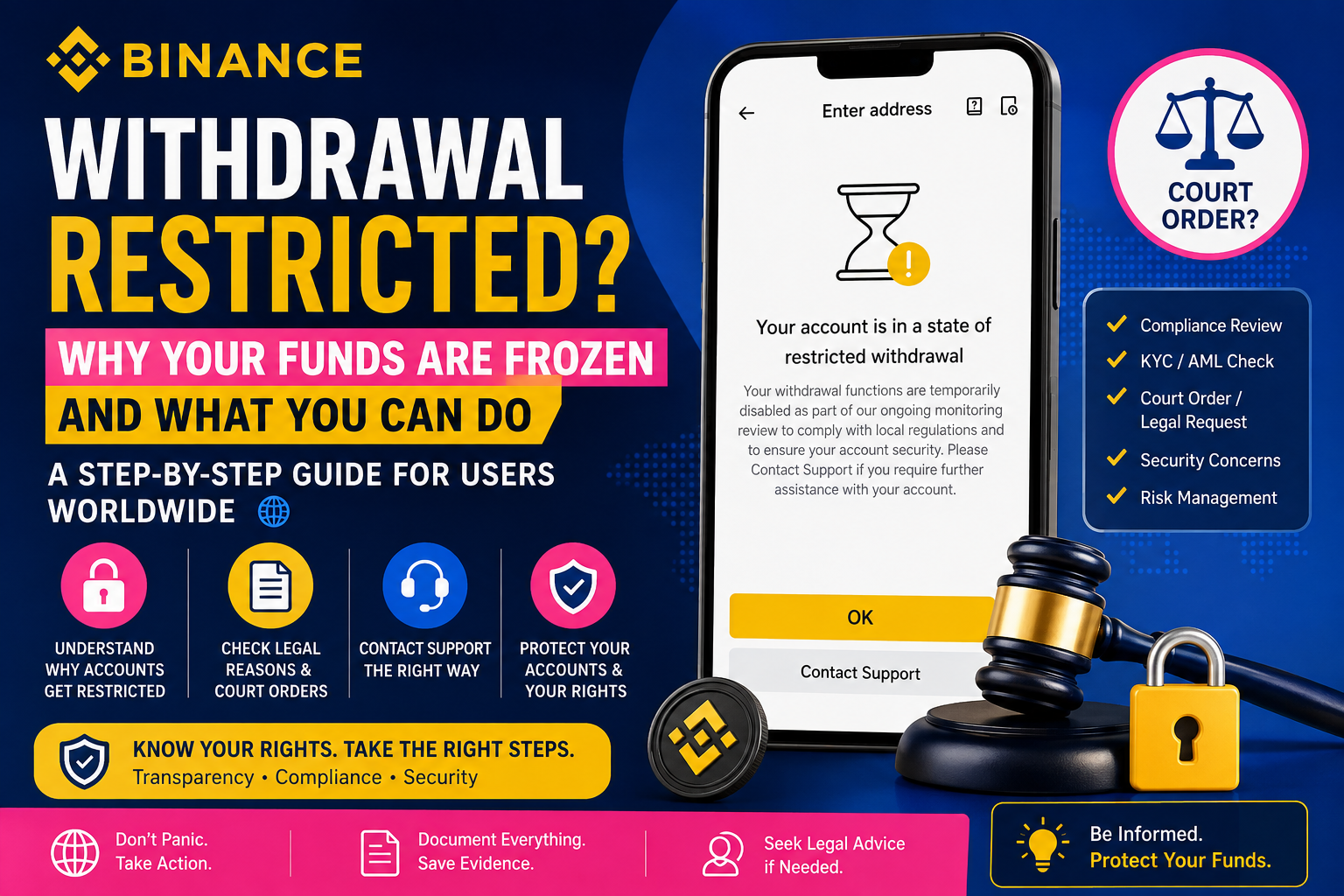
A screenshot shared for this article illustrates one type of restriction. The message states:
“Your account is in a state of restricted withdrawal.”
It further explains that withdrawals have been temporarily disabled as part of an ongoing monitoring review to comply with local regulations and protect account security.
A separate user report on Reddit describes a different situation. The user says Binance attributed a withdrawal restriction to a US federal court order and provided case number 1:26-cv-05425-SKC. The user questioned why cryptocurrency conversion and internal transfers remained possible while external withdrawals were restricted.
These examples raise legitimate questions, but they should not be treated as proof that every Binance withdrawal restriction has the same legal basis.
1. Why does Binance restrict withdrawals?
A withdrawal restriction does not necessarily mean that an exchange has confiscated the customer’s cryptocurrency or that a court has ordered the seizure of all account assets.
There are several possible explanations.
A. Compliance and monitoring review
An exchange may review an account when its monitoring systems identify transactions or account activity requiring additional investigation.
Possible triggers include:
- Deposits or withdrawals connected with high-risk wallet addresses.
- Transactions involving suspected scams or fraudulent activities.
- Unusual transaction patterns.
- Questions about the origin or ownership of funds.
- Transactions involving third-party services or platforms requiring additional compliance checks.
- Incomplete customer information or outstanding KYC requirements.
The exchange may request additional information before deciding whether normal withdrawal functionality can resume.
B. Identity verification and account security
Withdrawal restrictions may also result from security-related events, including:
- Password changes.
- Changes to two-factor authentication.
- New devices or unusual login activity.
- Incomplete identity verification.
- Changes in account security settings.
Binance’s published guidance identifies certain security operations and abnormal account activities as possible reasons for temporary withdrawal suspension.
Official reference:
https://www.binance.com/en-GB/support/faq/how-to-reactivate-the-withdrawal-function-for-my-binance-account-360038583951
C. Law-enforcement or court-related restrictions
In some circumstances, an exchange may restrict assets or account functions in response to a lawful request, regulatory direction, court order or other legal obligation.
This is different from an ordinary security review.
If an exchange specifically claims that a court order applies, the customer should seek clarification about the legal basis, the scope of the restriction and the procedure available for addressing it.
An exchange may be legally restricted from disclosing certain investigative information. Nevertheless, customers should preserve the explanation they receive and obtain independent legal advice where substantial assets are affected.
2. Does being able to convert USDT into another cryptocurrency mean your funds are not frozen?
Not necessarily.
This is one of the most misunderstood aspects of exchange withdrawal restrictions.
A cryptocurrency exchange can apply different controls to different account functions. For example:
- External withdrawals may be disabled.
- Internal transfers between account sections may remain available.
- Trading or conversion may remain operational.
- Particular assets or transaction amounts may be restricted.
- An account may remain accessible while certain functions are suspended.
Therefore, the ability to convert USDT into SOL, BTC or another cryptocurrency does not independently establish that the assets are free from legal restrictions.
A conversion within an exchange may simply change the asset recorded in the customer’s account. It does not necessarily permit the customer to transfer the resulting cryptocurrency outside the exchange.
Binance.US also publishes examples of circumstances in which trading can remain available while withdrawals are subject to a hold. However, Binance.com and Binance.US are distinct services, and their policies should not be assumed to be identical.
The important question is not merely whether conversion is possible. It is precisely which assets and functions are restricted, and under what authority.
3. The reported US court case: What does it establish?
A Binance user reported receiving the case number:
1:26-cv-05425-SKC
The user stated that Binance associated the restriction with the US District Court for the District of Colorado.
A search of the court’s public record identifies this case as:
Hossan Parbas et al. v. Huione Global, LTD et al.
The public docket entry is dated October 22, 2026, and is marked sealed. It records a motion for leave to restrict.
This is an important distinction:
- The case number appears in an official court record.
- The public docket identifies the parties and indicates that the matter has sealed material.
- The publicly available entry does not establish the contents of the relevant order.
- It does not independently establish that the reported Binance user’s account or assets are covered by that order.
A customer should therefore request confirmation from Binance about the specific legal restriction applicable to their account, to the extent Binance is legally permitted to provide it.
A sealed court proceeding should not be interpreted through assumptions or speculation.
4. Step-by-step guide: What should Binance users do?
The following procedure is intended for users in different countries who encounter withdrawal restrictions. The precise legal options depend on the Binance entity serving the customer, their country of residence and the reason for the restriction.
Step 1: Preserve the withdrawal restriction message
Take clear screenshots of:
- The withdrawal restriction notification.
- The account balance and affected assets.
- Any error message displayed when attempting a withdrawal.
- The date and time of the restriction.
- Relevant transaction history.
Keep the original screenshots and files. Do not edit them in a way that changes their evidential value.
Step 2: Download your transaction history
Where available, download the relevant transaction records.
Preserve:
- Deposit records.
- Withdrawal records.
- Internal transfer records.
- Conversion and trading history.
- Transaction IDs (TXIDs).
- Wallet addresses.
- Dates, amounts and asset types.
This information may be important in identifying the transactions that preceded the restriction.
Step 3: Contact Binance through official support
Use the support function inside the official Binance application or website.
Avoid telephone numbers, Telegram accounts, WhatsApp contacts or social media accounts claiming to be Binance recovery agents.
Ask Binance to clarify:
- Is the restriction related to a security review, KYC/AML review, risk-control measure or legal order?
- Does the restriction affect the entire account or only particular assets?
- Are external withdrawals disabled while trading and conversion remain available?
- Is additional documentation required from the customer?
- Is there an appeal or review procedure?
- Is there an estimated review period, if one can legally be provided?
Save the support ticket number and complete conversation.
Step 4: Ask for the legal basis if Binance cites a court order
If Binance tells you that your assets are restricted under a court order, request the following information to the extent legally disclosable:
- Court name and jurisdiction.
- Case or docket number.
- Date of the order.
- Whether the restriction concerns the entire account or specified assets.
- Whether the order concerns a particular transaction or wallet address.
- Whether the customer is named in the proceedings or is affected as a third party.
- Whether a procedure exists to challenge the restriction or seek clarification.
Do not assume that a case number alone proves that your particular assets are covered by the order.
Step 5: Verify the court case independently
If a US federal court case is cited, use the official federal court resources.
For the reported District of Colorado case, the court’s website is:
PACER is the official US federal court records access system:
Where a docket is sealed, public access may be limited. A lawyer may need to determine whether the customer has a legally available route to obtain clarification or seek relief.
For restrictions connected to another country, identify the relevant court, financial regulator or law-enforcement authority in that jurisdiction.
Step 6: Complete legitimate KYC and compliance requests
If Binance requests additional documentation, respond accurately and within the stated deadline.
Depending on the circumstances, useful records may include:
- Passport or national identity document.
- Proof of residential address.
- Bank statements.
- Exchange deposit and withdrawal records.
- Transaction receipts.
- Evidence of the source of funds.
- Documents relating to the original purchase of cryptocurrency.
- Contracts, invoices or other records explaining the commercial purpose of transfers.
Never submit fabricated documents, altered bank statements or misleading explanations.
If a transaction originated from another exchange or wallet, provide a clear explanation supported by available records.
Step 7: Prepare a transaction-source report
Where the restriction appears connected to blockchain activity, consider obtaining a professional transaction analysis.
A useful report may identify:
- The original source wallet.
- The receiving wallet.
- Relevant blockchain networks.
- Transaction IDs.
- Subsequent transfers.
- Exchange deposit addresses, where identifiable.
- Known high-risk or flagged addresses.
- The relationship between the customer’s legitimate transactions and the questioned transfers.
Blockchain tracing can provide useful evidence, but it does not independently prove the identity or criminal responsibility of a wallet controller.
Step 8: Submit a formal written complaint or appeal
If ordinary support does not resolve the matter, prepare a formal complaint.
The complaint should include:
- Customer account details, provided privately through verified channels.
- The date the restriction began.
- Relevant support ticket references.
- The assets and amounts affected.
- The exchange’s explanation.
- The customer’s response to any compliance questions.
- Supporting transaction records.
- A clear request for review and written clarification.
Ask for a written decision or an explanation of the next procedural step.
Step 9: Identify the correct regulator or dispute-resolution route
Binance services may be operated through different legal entities depending on the country and product.
Consequently, the appropriate complaint route is not necessarily the same for every customer.
Identify:
- The contracting Binance entity.
- The applicable terms of service.
- The customer’s country of residence.
- The relevant financial-services regulator, where applicable.
- Any contractual complaint or dispute-resolution mechanism.
Do not automatically assume that a US regulator or court has jurisdiction over every international Binance customer.
Step 10: Obtain independent legal advice where necessary
If substantial assets remain inaccessible, the restriction continues without meaningful clarification, or Binance expressly refers to a court or law-enforcement order, consider obtaining advice from a lawyer familiar with cryptocurrency regulation, exchange disputes and the relevant jurisdiction.
Depending on the facts, legal options may include:
- A formal legal notice.
- A regulatory complaint.
- A request for clarification or disclosure through an appropriate legal procedure.
- Court proceedings where a viable legal basis exists.
- An application for relief, where available and legally justified.
No lawyer can guarantee that an exchange will release restricted assets. A genuine legal order or regulatory obligation may limit the exchange’s ability to do so.
5. What should users avoid doing?
Users facing withdrawal restrictions should be particularly careful about the following:
Do not pay recovery agents who promise guaranteed release. Fraudsters frequently target people whose cryptocurrency is already inaccessible.
Do not share passwords, OTPs or private keys. Genuine exchange support should not require your account password or wallet seed phrase.
Do not attempt to bypass restrictions through another account. This may create additional compliance concerns.
Do not transfer funds through unknown intermediaries. Such transfers may expose users to further losses.
Do not delete support conversations or transaction records. Preserve all evidence.
Do not publicly disclose account UIDs, identity documents or private support correspondence containing personal information.
6. A sample message to Binance Support
Users may adapt the following message to their individual circumstances.
Subject: Formal Request for Clarification and Review of Withdrawal Restriction
Dear Binance Support Team,
My account is currently subject to a withdrawal restriction. I can access my account and view my balances; however, I am unable to withdraw my cryptocurrency.
Please clarify the nature and scope of this restriction.
In particular, I request confirmation of:
- Whether the restriction results from an internal compliance review, security measure, regulatory direction or court order.
- Which assets and account functions are affected.
- Whether any additional KYC, source-of-funds or transaction documentation is required.
- Whether there is an appeal or formal review procedure.
- If a court order is involved, the court name, case reference and date of the order, to the extent legally permissible to disclose.
I am willing to cooperate with legitimate compliance and verification requirements. I respectfully request that my case be reviewed and that the next available procedural steps be communicated in writing.
Kind regards,
[Customer Name]
7. Important considerations for Binance users in different countries
There is no single worldwide procedure for challenging a Binance withdrawal restriction.
The correct approach depends on the legal entity providing the service, the customer’s location and the applicable regulatory framework.
For example:
- A customer in Pakistan should examine the applicable contractual arrangements and relevant Pakistani legal and regulatory routes.
- A customer in the European Union should consider the relevant EU regulatory framework and the entity providing the service.
- A customer in the United Kingdom should identify the applicable UK service provider and available complaint mechanisms.
- A customer in the United States should consider the relevant US entity, applicable federal or state law and any court proceedings.
- Customers in other jurisdictions should identify their local legal framework and the exchange entity with which they contracted.
A US court order does not automatically establish that every international Binance account is subject to the same restriction. The legal connection between the order, the exchange entity, the assets and the customer must be examined.
Conclusion
A Binance withdrawal restriction should never be ignored, but it should not automatically be interpreted as confiscation, theft or proof of criminal involvement.
The ability to log in, trade or convert cryptocurrency does not necessarily mean that external withdrawals are permitted. Similarly, a reference to a court order should be investigated rather than accepted without understanding its scope.
The most practical response is to preserve evidence, obtain the exchange’s explanation, complete legitimate verification requests, identify the relevant legal entity and seek independent legal advice where necessary.
Users deserve a clear explanation of the restrictions affecting their assets, a fair opportunity to provide relevant documentation and access to whatever complaint or legal remedies are available under the applicable law.
Author: Shahid Jamal Tubrazy
Crypto & Fintech Legal Consultant
Crypto Law Consult
Website: https://cryptolawconsult.com/
Legal disclaimer: This article is for general educational and informational purposes and does not constitute legal advice. It does not establish that Binance has acted unlawfully or that any particular customer is entitled to immediate withdrawal. Each matter must be assessed individually under the applicable contractual terms and jurisdictional law.