
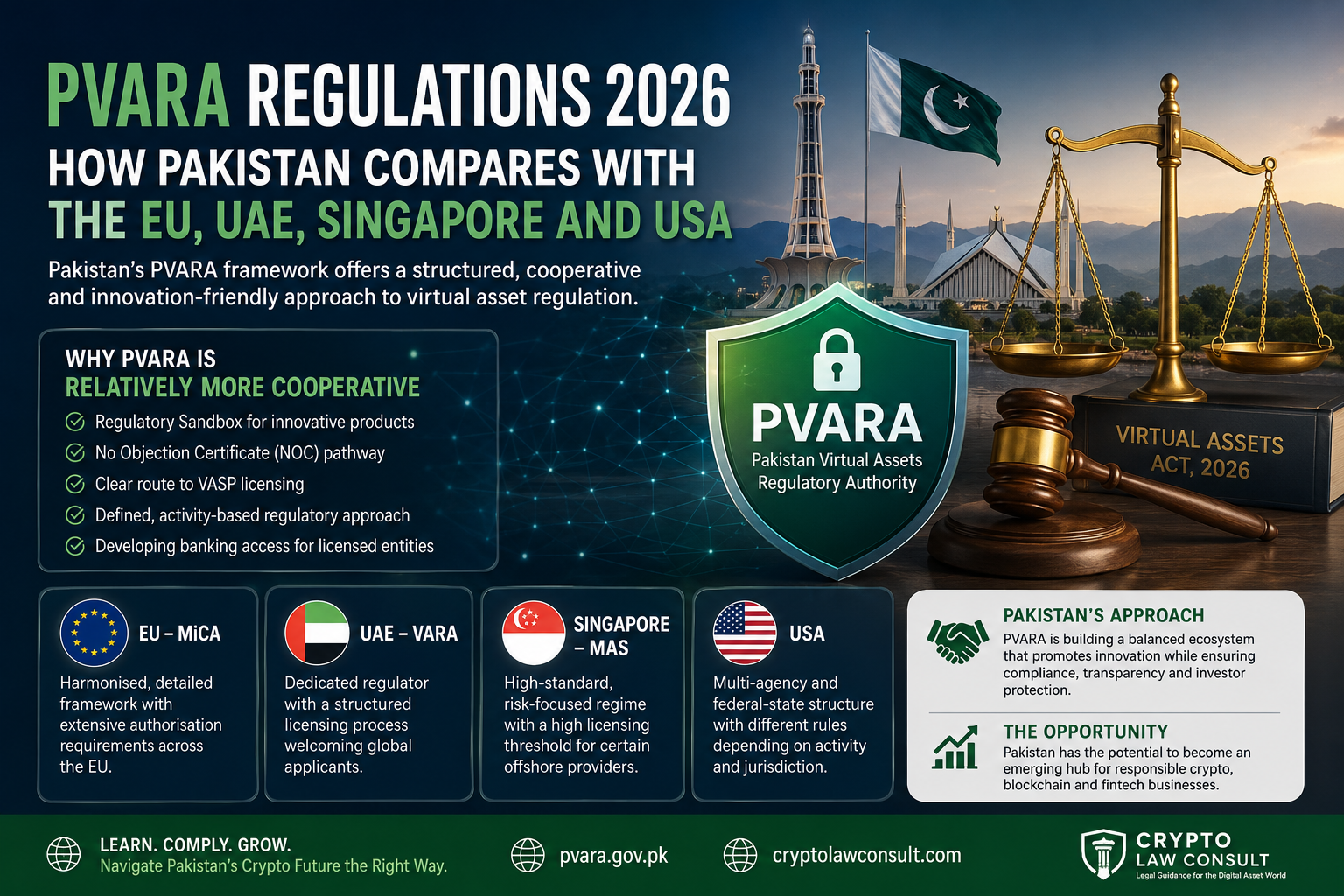
PVARA Crypto Regulations 2026: How Pakistan Compares with the EU, UAE and USA
For several years, Pakistan’s cryptocurrency market operated in an environment of regulatory uncertainty. Businesses, investors and technology entrepreneurs faced difficulties understanding the legal position of virtual-asset services, banking access and regulatory compliance.
The introduction of the Virtual Assets Act, 2026, followed by the establishment of the Pakistan Virtual Assets Regulatory Authority (PVARA), represents a significant change. Pakistan has moved towards a formal licensing and supervisory framework for virtual-asset service providers (VASPs).
However, the importance of this development goes beyond the introduction of licensing requirements. The structure of the PVARA framework suggests an approach that seeks to regulate the sector while providing businesses with defined routes to engage with the regulator, test innovative products and pursue authorisation.
When compared with the European Union, Singapore, Dubai and the United States, Pakistan’s framework presents an interesting proposition: a relatively cooperative and emerging regulatory environment, although one that still imposes substantial compliance obligations.
1. Understanding Pakistan’s PVARA Framework
The Virtual Assets Act, 2026, establishes PVARA as the statutory authority responsible for licensing, regulating and supervising virtual-asset activities in Pakistan.
The regulatory framework was further developed through two important instruments notified on 21 August 2026:
- Pakistan Virtual Asset Services Regulations, 2026.
- Pakistan Virtual Asset Services Activity Specific Regulations, 2026.
Together, these instruments address licensing, governance, capital requirements, risk management, technology, customer-asset protection and anti-money laundering and counter-terrorist financing obligations.
PVARA’s framework covers a range of activities, including exchanges, custody, brokerage, advisory services, virtual-asset management, transfer and settlement, lending and borrowing, derivatives, and certain token issuance activities.
This activity-based structure is important because a business must obtain authorisation for the services it actually intends to provide. A licence for one category should not be treated as permission to conduct every other virtual-asset activity.
Official sources: Virtual Assets Act, 2026 | PVARA Regulations | PVARA Licensing
2. Why PVARA Appears Relatively More Cooperative
One of the most notable features of Pakistan’s framework is its structured market-entry approach.
Rather than presenting businesses with only a single full-licensing route, PVARA provides different regulatory pathways, including:
Regulatory Sandbox: Businesses developing innovative virtual-asset products can seek an opportunity to test their solutions under regulatory supervision, subject to applicable conditions and limitations.
No Objection Certificate (NOC): The NOC route provides a preliminary regulatory pathway for eligible businesses. It is not a full VASP licence and should not be represented as unrestricted permission to operate.
VASP Licensing: Businesses can proceed through the formal licensing process once the applicable corporate, financial, governance and compliance requirements have been met.
This staged approach can be particularly useful for start-ups, international fintech companies and blockchain businesses that need to understand regulatory expectations before committing substantial resources to a full market launch.
Another important development is the State Bank of Pakistan’s circular framework allowing eligible PVARA-licensed VASPs, and qualifying NOC entities subject to specified conditions, to access banking arrangements.
This is significant because access to banking infrastructure is one of the practical challenges facing virtual-asset businesses in many jurisdictions.
The cooperative aspect should therefore be understood as a regulatory design feature: defined application pathways, a sandbox mechanism and a formal route towards regulated banking access. It does not mean that PVARA has waived compliance or capital requirements.
Sources: PVARA Licensing | State Bank of Pakistan Circular
3. PVARA Compared with the European Union’s MiCA Framework
The European Union’s Markets in Crypto-Assets Regulation (MiCA) provides a harmonised regulatory framework for crypto-asset issuers and crypto-asset service providers across the EU.
MiCA is designed to establish common standards covering authorisation, governance, prudential safeguards, disclosure, market integrity, consumer protection and operational resilience.
Under Article 62 of MiCA, applicants seeking authorisation as crypto-asset service providers must submit extensive information concerning their business operations, governance, financial safeguards, management, shareholders, internal controls, technology, cybersecurity and customer-asset arrangements.
Compared with this framework, Pakistan’s PVARA system offers an interesting staged entry structure through its NOC and sandbox routes.
The distinction: MiCA provides a harmonised EU-wide regulatory framework with detailed authorisation requirements, while PVARA is developing a national licensing system with specific preliminary engagement pathways.
For businesses seeking access to the European market, MiCA provides a common regulatory structure across participating EU jurisdictions. For businesses considering Pakistan, the availability of preliminary regulatory pathways may make initial engagement more accessible.
This does not establish that Pakistan’s overall compliance burden is lower. Both frameworks require serious regulatory preparation.
Source: European Commission – Crypto-assets and MiCA | ESMA – MiCA Article 62
4. PVARA Compared with Dubai’s VARA Framework
Dubai has become an important destination for virtual-asset businesses through the Virtual Assets Regulatory Authority (VARA), which regulates virtual-asset activities across Dubai, excluding the Dubai International Financial Centre (DIFC).
VARA openly welcomes applications from qualifying firms based in the UAE and overseas. Its licensing process includes an initial Approval to Incorporate stage, followed by the full VASP licensing process.
Applicants must satisfy requirements relating to corporate structure, ultimate beneficial ownership, management fitness, source of funds, governance, financial projections, capital, technology, compliance and risk management.
There are similarities between the Pakistani and Dubai approaches.
Both frameworks recognise that licensing should involve engagement with the regulator and that businesses need to satisfy activity-specific requirements. Both also provide structured processes before a business can operate as a fully authorised VASP.
The difference is that PVARA offers an expressly identified regulatory sandbox and an NOC-to-licence route, whereas VARA uses its own staged approval and licensing process.
Dubai is already an established international virtual-asset hub with a developed supervisory framework. Pakistan, by contrast, is building its regulated market and may offer an opportunity for businesses prepared to enter at an earlier stage of market development.
It would therefore be inaccurate to suggest that Pakistan is automatically easier or more attractive than Dubai. The appropriate jurisdiction depends on the proposed business model, target customers, capital, operational location and regulatory strategy.
Source: Dubai VARA – Licence Applications
5. PVARA Compared with Singapore’s MAS Framework
Singapore’s Monetary Authority of Singapore (MAS) is recognised for its sophisticated financial-services regulatory system.
Digital payment token services are regulated under Singapore’s Payment Services Act, while other digital-token activities may fall under securities, financial-advisory or other regulatory legislation, depending on their characteristics.
Singapore also introduced a Digital Token Service Provider (DTSP) licensing regime under the Financial Services and Markets Act 2022.
In its June 2025 clarification, MAS stated that it had set a high licensing threshold for certain DTSPs providing services exclusively to customers outside Singapore and would generally not issue licences for those business models.
This is an important contrast with Pakistan’s emerging market-entry approach.
PVARA provides a sandbox and preliminary NOC pathway for eligible businesses seeking to engage with Pakistan’s regulatory system. Singapore, on the other hand, has taken a particularly restrictive position towards the specified offshore-only DTSP business model.
However, Singapore remains an attractive financial centre for appropriately structured and licensed digital-token businesses. The comparison concerns the regulatory treatment of particular business models, not the overall quality or attractiveness of either jurisdiction.
Source: MAS – Regulatory Regime for Digital Token Service Providers
6. PVARA Compared with the United States
The United States has historically presented a complex regulatory environment for cryptocurrency businesses.
Depending on the activity and the legal classification of a digital asset, a business may face obligations involving the Securities and Exchange Commission (SEC), Commodity Futures Trading Commission (CFTC), Financial Crimes Enforcement Network (FinCEN), state financial regulators and other authorities.
For example, a business conducting money transmission involving virtual assets may need to consider FinCEN registration and applicable state money-transmission licensing. New York’s BitLicense and other state-level requirements add further complexity.
The SEC also announced a proposed tailored securities-offering regime for certain crypto-asset investment contracts in August 2026, illustrating the continuing development of the US regulatory landscape.
Compared with this multi-agency and state-federal structure, PVARA offers a dedicated federal authority for the licensing and supervision of covered virtual-asset activities in Pakistan.
For a business seeking to understand which authority is responsible for its VASP licensing process, a dedicated regulator can offer greater institutional clarity.
Nevertheless, US federal and state obligations may still apply to businesses with relevant US operations, customers or regulated activities. A Pakistani PVARA licence does not replace US registration or licensing requirements.
Sources: SEC – Proposed Regulation Crypto Assets | US Crypto-Asset Regulatory Overview
7. Comparative Overview: Five Regulatory Approaches
| Jurisdiction | Regulatory approach | Notable feature |
|---|---|---|
| Pakistan – PVARA | Emerging, staged and engagement-oriented | Sandbox, NOC and VASP licensing |
| European Union – MiCA | Harmonised and detailed | Common authorisation framework across the EU |
| Dubai – VARA | Dedicated and activity-based | Approval to Incorporate followed by VASP licensing |
| Singapore – MAS | High-standard and risk-focused | Restrictive approach to specified offshore-only DTSPs |
| United States | Multi-agency and federal-state | Different regulatory regimes depending on activity and location |
The comparison demonstrates that there is no single global model for crypto regulation. Each jurisdiction has developed its own approach based on financial stability, investor protection, market development and financial-crime risks.
8. Capital Requirements and Compliance: Is Pakistan Really More Flexible?
A cooperative regulatory approach should not be confused with low entry costs.
Under the PVARA Services Regulations, 2026, minimum paid-up capital varies according to the licence category:
| Licence category | Minimum paid-up capital |
|---|---|
| Advisory services | PKR 15 million |
| Broker-dealer services | PKR 75 million |
| Custody services | PKR 200 million |
| Virtual-asset management and investment | PKR 200 million |
| Transfer and settlement | PKR 200 million |
| Fiat-referenced token issuance | PKR 300 million |
| Asset-referenced token issuance | PKR 300 million |
| Exchange services | PKR 500 million |
| Lending and borrowing | PKR 500 million |
| Derivatives services | PKR 500 million |
| Mining-related virtual-asset services | PKR 500 million |
Applicants must also meet the applicable corporate requirements, including incorporation under the Companies Act, 2017, and a minimum of three directors.
Licensed businesses must implement appropriate AML/CFT/CPF controls, customer due diligence, transaction monitoring, sanctions screening, recordkeeping, suspicious-activity reporting, cybersecurity and customer-asset safeguards.
Consequently, PVARA should not be viewed as a low-compliance jurisdiction. Its potential advantage lies in the structure of regulatory engagement and market entry, rather than the absence of regulatory obligations.
Source: PVARA Regulations and Licensing Information
9. What Should International Crypto Businesses Do?
International businesses considering Pakistan should undertake a proper regulatory assessment before launching services or marketing to Pakistani customers.
The recommended steps include:
- Identify the exact virtual-asset activities proposed in Pakistan.
- Determine the applicable PVARA licence categories.
- Review the NOC, sandbox and licensing pathways.
- Assess capital, corporate governance and local incorporation requirements.
- Prepare AML/CFT/CPF, cybersecurity and customer-asset protection policies.
- Review banking arrangements and applicable State Bank requirements.
- Assess tax, data protection, foreign-exchange and cross-border obligations.
- Obtain a legal opinion before onboarding customers or commencing regulated activities.
Businesses that were operating during the statutory transitional period should also review the September 5, 2026 NOC deadline under section 70 of the Virtual Assets Act, 2026. The deadline has passed, and affected businesses should not assume that a pending or incomplete application automatically authorises continued operations.
Conclusion: Pakistan Has an Opportunity to Become a Cooperative Crypto Regulatory Market
Pakistan’s PVARA framework represents an important move towards a formal and supervised virtual-asset industry.
Its regulatory sandbox, NOC pathway, activity-specific licensing and developing banking arrangements create a potentially constructive environment for businesses seeking regulatory engagement.
Compared with the EU’s detailed harmonised framework, Singapore’s high licensing threshold for certain offshore-only providers and the United States’ fragmented regulatory structure, Pakistan offers a different proposition: a dedicated national regulator with defined preliminary market-entry routes.
Dubai provides another important comparison, as it too welcomes qualifying international applicants through a structured licensing process.
The real test for PVARA will be how consistently and transparently it implements its framework, communicates with applicants, processes applications and supervises licensed businesses.
If regulatory engagement remains practical, predictable and proportionate, Pakistan could strengthen its position as an emerging destination for responsible cryptocurrency, blockchain and fintech businesses.
The opportunity is not to become an unregulated crypto market. It is to become a jurisdiction where innovation and regulatory compliance can develop together.
About the Author
Shahid Jamal Tubrazy is a Cryptocurrency and Fintech Legal Consultant and Managing Director of Crypto Law Consult. His professional work focuses on cryptocurrency regulation, virtual-asset licensing, blockchain business structuring, fintech compliance and international crypto-related legal matters.
Website: https://cryptolawconsult.com/
Disclaimer: This article is for general informational and educational purposes and does not constitute legal, financial or investment advice. Regulatory requirements may change, and businesses should obtain jurisdiction-specific legal advice before commencing virtual-asset activities.