Is P2P Crypto Trading Illegal in Pakistan?
Peer-to-peer (P2P) cryptocurrency trading has become a common way for individuals to buy and sell virtual assets such as USDT and Bitcoin. In Pakistan, however, many users remain uncertain about whether buying or selling cryptocurrency directly with another individual is illegal, whether they need a PVARA licence, and what legal risks they should consider.
The introduction of the Virtual Assets Act, 2026 and the establishment of the Pakistan Virtual Assets Regulatory Authority (PVARA) have changed the regulatory landscape.
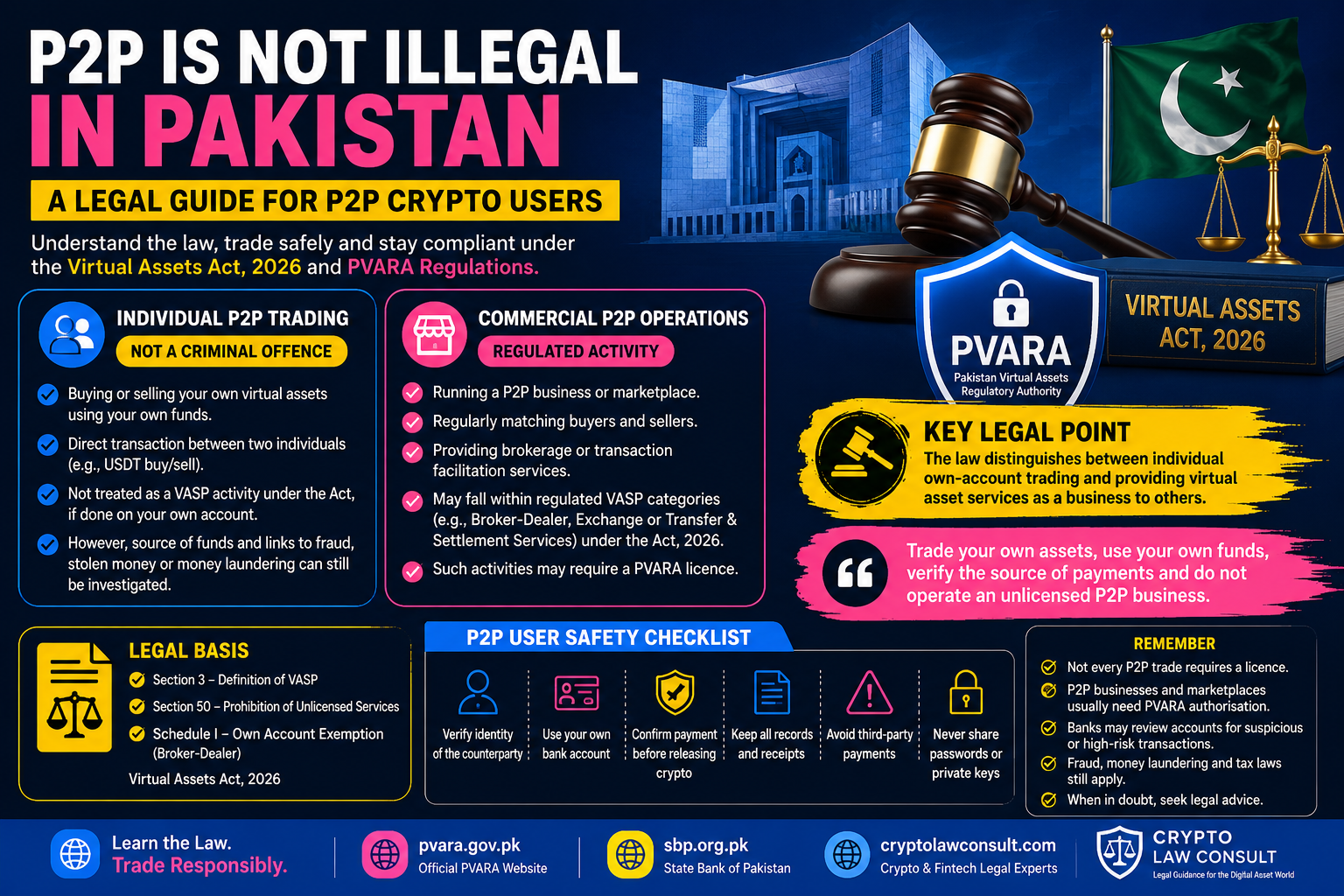
An important legal distinction must be understood: a private individual selling or purchasing their own virtual assets is not necessarily carrying on a regulated virtual-asset service business. However, operating a commercial P2P brokerage, exchange or transaction-facilitation service may require PVARA authorisation.
This guide explains the distinction and provides practical precautions for individuals participating in P2P transactions in Pakistan.
1. Is Individual P2P Trading Illegal in Pakistan?
The Virtual Assets Act, 2026 establishes a regulatory framework primarily directed at virtual-asset service providers (VASPs), issuers and businesses conducting regulated virtual-asset activities.
Section 3 defines a VASP as a person who, as a business, provides one or more virtual-asset services to third parties on a professional basis.
This distinction matters.
For example, consider two individuals:
- Person A owns USDT and wants to sell it.
- Person B wants to purchase USDT using their own funds.
- Both agree on the quantity, price and payment method.
- They independently complete the transaction without a commercial intermediary providing brokerage or exchange services.
On these facts, the transaction does not automatically make either individual a PVARA-regulated VASP.
The Act also contains an express exemption in Schedule I for a person dealing solely on their own account, who does not execute orders on behalf of customers and does not hold or control customer assets, from being regarded as carrying on broker-dealer services.
Important: This is a limited statutory distinction, not a blanket declaration that all individual P2P transactions are lawful in every circumstance. Other applicable laws, including those relating to fraud, money laundering, taxation and foreign exchange, may still apply.
2. Individual P2P Trading vs Commercial P2P Operations
The legal distinction becomes particularly important when a person moves beyond occasional personal transactions and starts providing services to other buyers and sellers.
Individual P2P trading
Examples may include:
- Buying USDT for personal use with your own money.
- Selling your personally owned Bitcoin or other virtual assets.
- Directly negotiating a transaction with another individual.
- Using your own wallet and maintaining control over your own virtual assets.
- Not charging brokerage or transaction-facilitation fees.
These activities do not automatically amount to operating a VASP business. The facts, frequency, commercial purpose and actual services provided remain relevant.
Commercial P2P operations
Examples include:
- Operating a P2P trading desk or marketplace.
- Regularly matching buyers and sellers for compensation.
- Accepting and executing customer orders.
- Providing brokerage or transaction-facilitation services.
- Operating an order book or exchange mechanism.
- Holding or controlling customers’ virtual assets during transactions.
Such activities may fall within regulated categories under Schedule I, including broker-dealer, exchange, custody or transfer and settlement services.
A business cannot avoid licensing requirements merely by describing itself as a P2P trader or informal trading group.
3. What Does the Virtual Assets Act, 2026 Actually Say?
Three provisions are particularly relevant to P2P users.
Section 3 – Definition of a Virtual Asset Service Provider
The Act defines a VASP by reference to providing virtual-asset services as a business to third parties on a professional basis.
This is relevant when distinguishing personal transactions from commercial service provision.
Section 50 – Prohibition of Unlicensed Virtual Asset Services
A person may not engage in or represent themselves as engaging in virtual-asset services by way of business in or from Pakistan without the required Pakistani corporate structure and valid PVARA licence.
Schedule I – Broker-Dealer Services
The Schedule includes arranging or facilitating orders for the purchase and sale of virtual assets between two parties.
However, it expressly excludes a person dealing solely on their own account, who does not execute orders on behalf of customers and does not hold or control customer assets, from the broker-dealer category.
This is particularly relevant to individuals who independently buy and sell their own virtual assets.
Official legislation: Virtual Assets Act, 2026 – PVARA
4. Practical Safety Guidelines for Individual P2P Users
Even where a transaction does not amount to a regulated VASP activity, P2P users should take reasonable precautions.
A. Use your own bank account
Whenever possible, make and receive payments through bank accounts held in your own legal name.
Avoid accepting payments from unrelated third parties. A payment from an unknown person may create complications if the funds are subsequently reported as fraudulent or connected with another person’s account.
B. Verify the identity of the counterparty
Before completing a transaction, establish the identity of the other party to a reasonable extent.
Keep a record of:
- The counterparty’s name and contact details.
- Relevant transaction communications.
- The agreed quantity and price.
- Payment confirmation.
- Wallet addresses and transaction IDs.
Do not share passwords, private keys, recovery phrases or one-time authentication codes.
C. Confirm payment before releasing cryptocurrency
Do not rely solely on screenshots or payment receipts supplied by the buyer.
Check your own banking application or obtain confirmation through the bank’s official channels before releasing the virtual assets.
A screenshot is not proof that funds have actually been credited.
D. Avoid third-party payments
One of the most significant risks in P2P transactions is receiving money from someone other than the person with whom you negotiated.
For example:
A buyer agrees to purchase USDT from you, but the bank transfer comes from an unrelated person’s account.
This may indicate a third-party payment arrangement, an account compromise or a fraudulent transaction.
Do not release the virtual assets until the discrepancy is properly resolved.
E. Keep transaction records
Maintain records of:
- Date and time of each transaction.
- Amount of fiat currency received or paid.
- Virtual asset and quantity exchanged.
- Wallet addresses.
- Transaction hashes (TXIDs).
- Bank transfer references.
- Communications and agreements.
These records may help explain the source and purpose of funds if a bank, regulator or law-enforcement authority raises questions.
F. Do not participate in suspicious transactions
Avoid transactions involving:
- Unknown third-party bank accounts.
- Suspected stolen funds.
- Fake payment receipts.
- Unexplained overpayments.
- Requests to return money to a different account.
- Attempts to conceal the actual source or beneficiary of funds.
If a transaction appears suspicious, pause it rather than attempting to complete it.
5. Can Your Bank Account Be Frozen Because of P2P Trading?
Yes, a bank account may be restricted, reviewed or investigated where a transaction raises concerns about fraud, money laundering, suspicious third-party payments or other unlawful activity.
However, a bank-account review does not automatically establish that the account holder has committed an offence.
If your account is restricted, consider taking the following steps:
- Obtain the bank’s written explanation or reference number, where available.
- Collect the relevant P2P communications and transaction records.
- Preserve bank statements and payment references.
- Preserve blockchain transaction IDs and wallet information.
- Identify the source and purpose of the funds.
- Respond to the bank’s compliance or investigation requests through appropriate channels.
- Obtain legal advice before making statements where fraud or criminal allegations are involved.
Never delete transaction records or attempt to conceal the source of funds.
6. Does PVARA Regulate Every Individual P2P Transaction?
No such blanket conclusion should be drawn from the Act.
PVARA’s framework is directed at regulated virtual-asset services and the businesses providing them. The legal question is whether the actual activity falls within a regulated service category and whether it is being conducted as a business.
For example:
| Activity | General regulatory consideration |
|---|---|
| Selling personally owned USDT | Not automatically a VASP business |
| Buying Bitcoin for personal use | Not automatically a VASP business |
| Selling your own assets without providing customer services | May fall within the own-account distinction |
| Matching buyers and sellers for a fee | May constitute broker-dealer services |
| Operating a commercial P2P marketplace | May require PVARA authorisation |
| Holding customer assets or funds | May trigger custody or other licensing requirements |
| Operating an exchange or order book | May constitute exchange services |
The classification depends on the actual business model, not merely the name used by the trader.
7. What About Banking and Other Applicable Laws?
The State Bank of Pakistan issued BPRD Circular Letter No. 10 on May 21, 2026, addressing bank accounts for PVARA-licensed VASPs, their customers and qualifying NOC entities.
The circular permits regulated banks to open accounts for duly licensed VASPs subject to specified conditions. It also provides for limited-purpose accounts for NOC holders to complete licensing formalities.
This is a regulated banking framework. It should not be interpreted as a general approval of every private P2P transaction or as permission for banks to trade or hold virtual assets using their own funds or customer deposits.
Other relevant legal considerations may include:
- Anti-Money Laundering Act, 2010.
- Applicable foreign-exchange requirements.
- Tax obligations under applicable tax legislation.
- Fraud and cybercrime laws.
- Banking and financial-sector compliance requirements.
Official reference: State Bank of Pakistan – Circular Letter No. 10
8. A Practical P2P Checklist Before Every Transaction
Individual P2P users should consider the following checklist:
- I am trading my own virtual assets and using my own funds.
- I have verified the counterparty’s identity to a reasonable extent.
- The payment is coming from the agreed person’s own account.
- The payment has actually been credited and is not merely supported by a screenshot.
- I have checked the quantity, price and wallet address.
- I have retained the bank and blockchain transaction records.
- I am not facilitating transactions for other people as a commercial service.
- I am not holding or controlling customer assets.
- I have no reason to suspect that the funds are stolen or connected with unlawful activity.
If you regularly arrange transactions for other people, charge commissions or operate a P2P desk, obtain a regulatory assessment before continuing.
9. Final Legal Position: Trade Carefully and Understand the Difference
The introduction of the Virtual Assets Act, 2026 does not mean that every individual buying or selling cryptocurrency directly with another individual automatically becomes a regulated VASP.
The Act’s definition of VASP and its express own-account exemption in Schedule I provide important legal distinctions between personal dealing and commercial brokerage.
Nevertheless, individuals should not interpret these provisions as unrestricted permission to conduct every type of cryptocurrency transaction. Fraud, suspicious funds, money laundering, third-party payments and other applicable legal issues remain relevant.
For P2P users, the practical approach is straightforward:
Trade your own assets, use your own funds, verify the source of payments, retain transaction records and do not operate an unlicensed commercial brokerage or exchange business.
For businesses, P2P desks and marketplace operators, a proper PVARA licensing assessment is essential.
About the Author
Shahid Jamal Tubrazy is a Cryptocurrency and Fintech Legal Consultant and Managing Director of Crypto Law Consult. His professional work includes virtual-asset regulation, cryptocurrency legal opinions, P2P transaction disputes, frozen exchange and bank accounts, blockchain business structuring and international crypto-related legal matters.
Website: https://cryptolawconsult.com/
Disclaimer: This article is for general legal information and educational purposes only. It does not constitute an individual legal opinion or guarantee that a particular P2P transaction is lawful. Legal classification depends on the facts, the nature of the activity and all applicable laws and regulations. Users and businesses should obtain independent legal advice before undertaking transactions or providing virtual-asset services.