10 Surprising Crypto Regulations Around the World
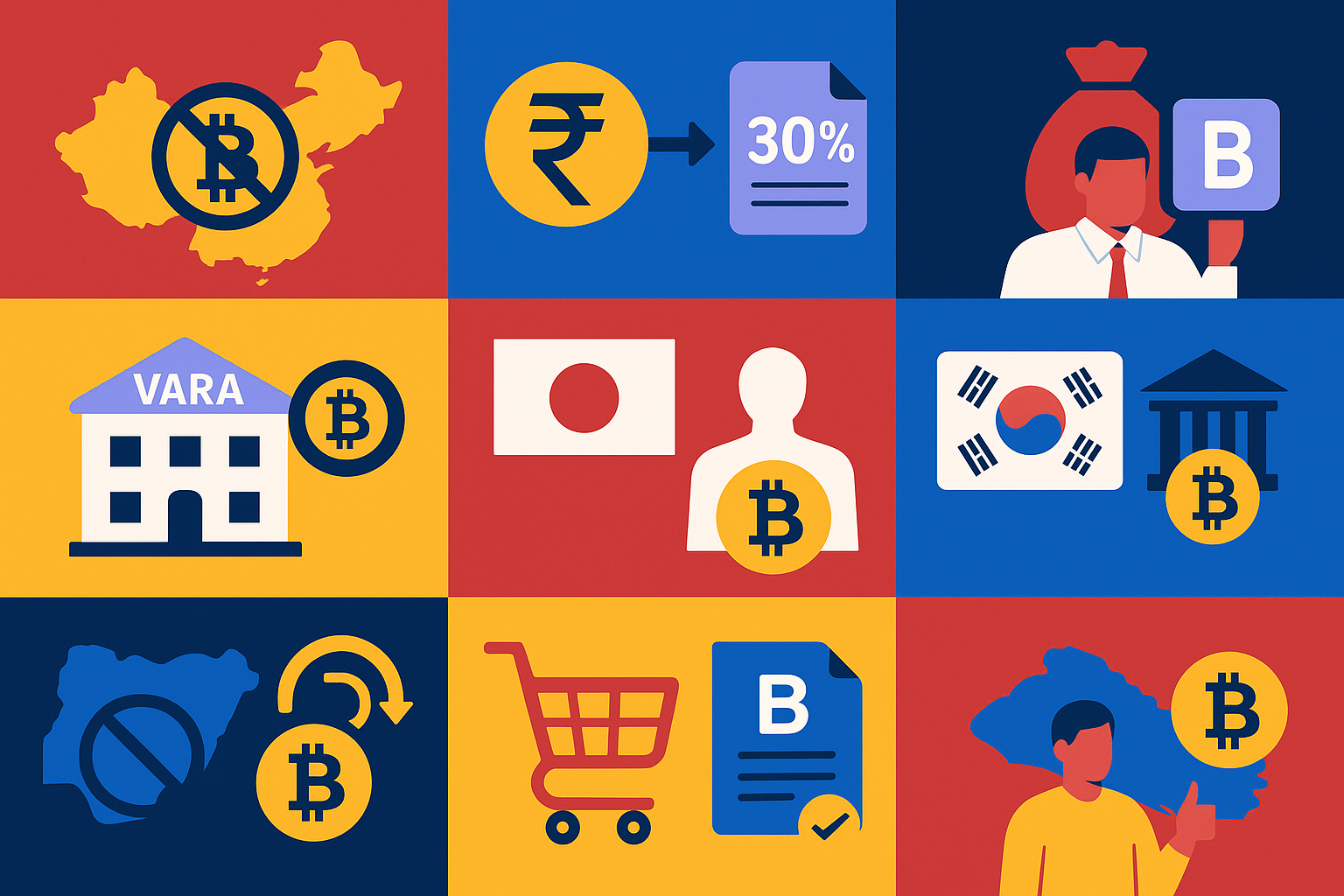
Cryptocurrency rules aren’t one-size-fits-all. Below I expand each of the 10 surprising regulations from the earlier list, explain why each is unusual or consequential, and link to authoritative reporting or primary material so you can read the original texts and reporting.
1) China — near-total ban on private crypto activity, while pushing state-controlled blockchain and a CBDC
China has repeatedly tightened restrictions since 2017 and in 2021 moved to make most cryptocurrency transactions and trading illegal — while simultaneously promoting state-controlled blockchain projects and accelerating its central bank digital currency (the e-CNY). The result is a striking split: private crypto trading/mining is heavily restricted, but “blockchain” and a government digital currency are actively encouraged. China Briefing
Why surprising: The government embraces distributed-ledger technology at a policy level but rejects private crypto markets — a split that complicates global business decisions and pushes Chinese crypto activity offshore.
2) India — flat 30% tax on gains + 1% TDS on transactions (and no loss offset)
India treats “virtual digital assets” (VDAs) under a special tax regime that imposes a flat 30% tax on gains from transfers of crypto and adds a 1% tax-deducted-at-source (TDS) on many transactions; importantly, losses from VDAs cannot generally be set off against other income under Section 115BBH. This design makes active trading costly and compliance-heavy. クリプタクト
Why surprising: Many jurisdictions allow capital-gains style treatment, offsetting of losses, and progressive rates; India’s hard-line flat tax plus routine TDS is unusually strict and frictional for traders.
3) New York (USA) — the BitLicense: heavy, state-level licensing for virtual-asset firms
New York’s BitLicense (NYSDFS framework) requires firms that engage in virtual-currency business activity with New York residents to obtain a state license, submit detailed compliance programs, and meet strict AML/KYC standards — making New York one of the most demanding regulatory regimes in the U.S. Department of Financial Services
Why surprising: A single U.S. state enforces a comprehensive license that effectively raises the bar (and costs) for firms wanting to operate with New York customers — pushing some providers to avoid the state altogether.
4) UAE — crypto-friendly free zones with tight supervision (VARA, DIFC, ADGM)
The UAE has created dedicated regulatory zones (e.g., Dubai’s VARA, Abu Dhabi Global Market, DIFC) that are attractive for crypto businesses — streamlined licensing, tax incentives, and infrastructure — but those zones also subject firms to close oversight, detailed audits and compliance reporting. Lightspark
Why surprising: It’s a “carrot and stick” model — very open to innovation in certain areas, but with strong, active supervision that can feel stricter than the promotional messaging implies.
5) Japan — regulator expects exchanges to reimburse victims and to hold reserves
Japan’s regulator and market practice have produced outcomes (and rule changes) that push exchanges to protect customers: following large hacks (e.g., Coincheck in 2018) exchanges have reimbursed users, and regulators have been moving toward formalizing requirements that exchanges maintain liability reserves or compensation mechanisms to cover customer losses. The Guardian
Why surprising: Many countries treat crypto as high-risk with limited consumer protection; Japan’s approach pushes toward mandatory consumer compensation — closer to protections found in traditional finance.
6) South Korea — mandatory real-name bank accounts for crypto trading
Since 2018 South Korea has required crypto traders to use real-name bank accounts linked to exchange accounts (and for exchanges to partner with banks) as part of AML and customer-identification measures. This eliminates much account anonymity and tightly integrates exchanges with the banking system. Nasdaq
Why surprising: The rule effectively removes the “anonymous on-ramp” seen in some markets and forces stronger identity controls at the interface between fiat and crypto.
7) Nigeria — banking restrictions pushed trading onto P2P, later partial rollbacks and regulation moves
Nigeria’s Central Bank issued directives in 2021 that prohibited banks from facilitating crypto transactions, which drove enormous peer-to-peer (P2P) activity. Later (Dec 2023 and onward) the CBN and Nigerian regulators moved to re-engage, issue guidelines for VASPs and consider stricter oversight — showing how bans can push markets underground and then trigger new regulatory frameworks. cbn.gov.ng
Why surprising: A banking sector ban didn’t eliminate crypto activity — it shifted it to informal channels, forcing regulators later to reverse or modify their stance and design targeted rules.
8) Thailand — trading allowed, but using crypto as an everyday payment method is restricted
Thailand permits trading and regulates exchanges but has restricted or explicitly discouraged the use of crypto as a general means of payment (depending on the product and license), separating investment/trading from retail payment systems. IBA
Why surprising: Many people assume “if trading is legal, paying with crypto must be too.” Thailand’s stance shows regulators can allow one activity while banning another.
9) Switzerland (Zug) — some cantons accept crypto for tax payments
Zug (the “Crypto Valley”) and certain Swiss municipalities/cantons allow taxpayers to pay taxes in Bitcoin or Ether, typically through an intermediary that converts crypto to CHF. Canton Zug formally authorized crypto tax payments as a novelty and economic incentive. zg.ch
Why surprising: Governments accepting taxes in crypto flips the “crypto as fringe asset” script — it’s a deliberate signaling move to attract fintech firms and investment.
10) El Salvador — Bitcoin as legal tender (and the later rollback/softening)
El Salvador made Bitcoin legal tender in 2021 (the first country to do so), requiring acceptance by many businesses and pushing a government wallet (Chivo). That experiment drew global attention — but also controversy and policy shifts: later agreements with the IMF and political adjustments led to rolling back or limiting some measures (e.g., mandatory acceptance/tax payments were scaled back in follow-on changes). This makes the El Salvador case one of the most closely watched — and most contested — national experiments in crypto policy. The Guardian+Reuters
Why surprising: A sovereign nation naming a private digital asset as money was unprecedented — and the political/economic consequences were immediate and contested.
Practical takeaways for lawyers, businesses and investors
- Regulation is uneven: national policy can be hostile, permissive, or experimental — sometimes simultaneously (e.g., China). China Briefing
- Taxes matter — big time: India’s approach shows how tax design (flat rates, TDS, no loss offset) can change the economics of trading. クリプタクト
- Licenses raise barriers: state or regional licenses (BitLicense, VARA, ADGM) are costly compliance gates that shape where businesses operate. Department of Financial Services
- Consumer protection is emerging: Japan’s trend toward exchange reserves/compensation is a model to watch for cross-border consumer protection. Bitcoin Magazine
- Bans don’t always stop markets: Nigeria’s experience shows restrictions often push activity into P2P or offshore channels, creating new AML/market-integrity challenges. cbn.gov.ng
Sources & further reading (quick links)
- China: explainer on 2021 prohibition and continuing enforcement. China Briefing
- India: analysis of 30% flat tax + 1% TDS and Section 115BBH. クリプタクト
- New York BitLicense (NYSDFS virtual currency business rules). Department of Financial Services
- UAE regulatory zones & guidance (VARA / DIFC / ADGM coverage). blockchainandthelaw.com
- Japan: Coincheck reimbursement and FSA coverage on reserves / consumer protection. The Guardian
- South Korea: real-name bank account rules and VASP requirements. Nasdaq
- Nigeria: CBN 2021 circular and later guidance reversing/adjusting the ban (Dec 2023 onward). cbn.gov.ng+Reuters
- Thailand: VASP and payment restrictions (regulator guidance summaries). sanctionscanner.com
- Switzerland (Zug): Canton of Zug tax payments with crypto. zg.ch
- El Salvador: Bitcoin Law (2021), Chivo wallet, and later IMF-linked rollbacks. The Guardian+Reuters
The information provided in this article is for general informational purposes only and does not constitute legal or financial advice.
Author & Crypto Consultant
Shahid Jamal Tubrazy (Crypto & Fintech Law Consultant)
Shahid Jamal Tubrazy, a certified top expert in Crypto Law from Duke University, is a leading authority in the cryptocurrency and blockchain space. As a seasoned Fintech lawyer, he offers a full spectrum of services, including licensing, legal guidance for ICOs, STOs, DeFi, and DAOs, as well as specialized expertise in crypto mediation, negotiation, and mergers and acquisitions. With a proven track record and published works on Blockchain Regulation and Cryptocurrency Laws, Shahid provides unparalleled insights into the complexities of the fintech world, ensuring compliance and strategic success. 🌐💼 #CryptoLaw #Fintech #Blockchain #LicenseServices #CryptoMediator #MergersAndAcquisitions #CryptoCompliance #FrozenAssetsrecovery.
EMAIL: shahidtubrazy@gmail.com
Website: https://cyberlawconsult.wixsite.com/cryptolawyer
Facebook: https://www.facebook.com/fintechcryptolawyer



2 Comments