
PVARA Licensing: The Ultimate Guide to Pakistan’s Fast-Growing Crypto Market
1. Introduction
Pakistan’s digital-asset landscape is entering a structured regulatory phase with the creation of the Pakistan Virtual Assets Regulatory Authority (PVARA) under the Virtual Assets Ordinance 2025. This framework represents the country’s first comprehensive regulatory model for Virtual Asset Service Providers (VASPs)—including exchanges, custodians, staking platforms, and blockchain-based intermediaries.
This evolution aligns Pakistan with global regulatory trends seen in markets such as the EU’s MiCA framework (https://finance.ec.europa.eu/regulation-and-supervision/financial-services-legislation/crypto-assets_en) and the FATF VASP recommendations (https://www.fatf-gafi.org/en/topics/fatf-recommendations.html).
2. Regulatory Background
2.1 Creation of PVARA
PVARA was established to regulate:
- Cryptocurrency exchanges
- Wallet and custodial services
- Staking/yield platforms
- Virtual asset transfers
- AML/CTF compliance obligations
This positions Pakistan to align with international standards followed by regulators such as the UAE Virtual Assets Regulatory Authority (VARA) (https://www.vara.ae/) and FCA UK Crypto Registration (https://www.fca.org.uk/cryptoassets).
2.2 Objectives of the Authority
PVARA is mandated to:
- Safeguard consumers from fraud and cyber threats
- Regulate high-risk virtual asset activities
- Ensure AML/CTF alignment with FATF standards
- Encourage responsible foreign investment
- Create legal certainty for crypto businesses
These objectives mirror global best practices used by entities like FinCEN (https://www.fincen.gov/) and the European Banking Authority (https://www.eba.europa.eu/).
3. Application Framework and Compliance Structure
3.1 Expression of Interest (EOI) for Crypto Firms
On 13 September 2025, PVARA announced a call for Expressions of Interest (EOI) from virtual asset service providers through its official portal (https://www.pvara.gov.pk/).
This invitation covers:
- Digital asset exchanges
- Custodial service providers
- Blockchain infrastructure firms
- Fintech companies integrating crypto services
Similar EOI models are used by regulators such as MAS Singapore (https://www.mas.gov.sg/regulation/explainers/digital-payment-token-services).
3.2 Public Register of Licensed Entities
Once fully launched, PVARA will maintain a public register of licensed VASPs, similar to public registers managed by:
- ESMA – European Securities Markets Authority (https://registers.esma.europa.eu/)
- ADGM Financial Services Regulatory Authority (https://www.adgm.com/doing-business/regulated-financial-institutions)
This register will detail licensed firms, approved activities, and compliance status.
4. Key Legal and Compliance Considerations
4.1 Alignment With Existing Regulators: SECP, SBP, and FIA
Crypto firms preparing to enter Pakistan must align with:
SECP – Securities and Exchange Commission of Pakistan
- Participation in the Regulatory Sandbox (https://www.secp.gov.pk/laws/regulatory-sandbox/)
- Testing digital asset models
- Following investor-protection guidelines
SBP – State Bank of Pakistan
- Ensuring compliance with crypto–fiat restrictions
- Following cross-border remittance controls
SBP guidelines are published at: https://www.sbp.org.pk/
FIA – Cybercrime Wing
- Compliance obligations under PECA 2016
- Data and cybersecurity requirements
FIA information: https://www.fia.gov.pk/
This integrated model mirrors multi-agency crypto governance seen in countries like the United States, where the SEC, CFTC, and FinCEN jointly oversee digital asset activities.
5. Regulatory Expectations for High-Risk Virtual Asset Activities
Custody, staking, and cross-border digital asset services require advanced compliance measures, including:
- FATF-aligned AML/KYC programs
- Enhanced Due Diligence (EDD)
- Transaction-monitoring systems
- Blockchain analytics tools (e.g., https://www.chainalysis.com/)
- Cybersecurity controls consistent with NIST standards (https://www.nist.gov/cyberframework)
These expectations are similar to requirements under the EU’s MiCA and Dubai VARA frameworks.
6. Strategic Implications for Crypto Companies Entering Pakistan
6.1 Preparing Before Licensing Fully Opens
Early preparation provides a competitive advantage. Crypto businesses should focus on:
- Drafting AML/KYC and compliance manuals
- Implementing risk-mapping frameworks
- Establishing cybersecurity and incident-response plans
- Creating governance structures
- Preparing custody and staking SOPs
This mirrors pre-licensing steps required in regions like Lithuania’s VASP registration system (https://www.registrucentras.lt/).
6.2 Using the SECP Sandbox as a Launchpad
The SECP Sandbox allows testing of:
- Exchange architecture
- Settlement systems
- Custody models
- Tokenization frameworks
Similar to the sandboxes operated by:
- FCA UK (https://www.fca.org.uk/firms/innovation/regulatory-sandbox)
- Bahrain CBB Sandbox (https://www.cbb.gov.bh/fintech/)
6.3 Cross-Border Structuring for Compliance
Many firms considering Pakistan adopt foreign VASP licenses, such as:
- Seychelles FSA (https://fsaseychelles.sc/)
- UAE VARA (https://www.vara.ae/)
- Lithuania FCIS VASP regime
- UK FCA Crypto Registration
These jurisdictions provide operational certainty while Pakistan’s domestic licensing completes development.
7. Conclusion
Pakistan’s move to regulate virtual assets through PVARA is a major step toward creating a modern, transparent, and secure digital-asset ecosystem. With the EOI phase open and a formal licensing register planned, the regulatory environment is steadily maturing.
Crypto companies that develop early compliance frameworks—covering AML/CTF, risk mapping, cybersecurity, custody controls, staking governance, and cross-border structuring—will be well positioned as Pakistan transitions into a fully operational licensing regime.
This forward-looking approach allows businesses to enter the Pakistani market responsibly while aligning with global standards set by FATF, MiCA, VARA, MAS, and other leading regulators.
The information provided in this article is for general informational purposes only and does not constitute legal or financial advice.
Author & Crypto Consultant
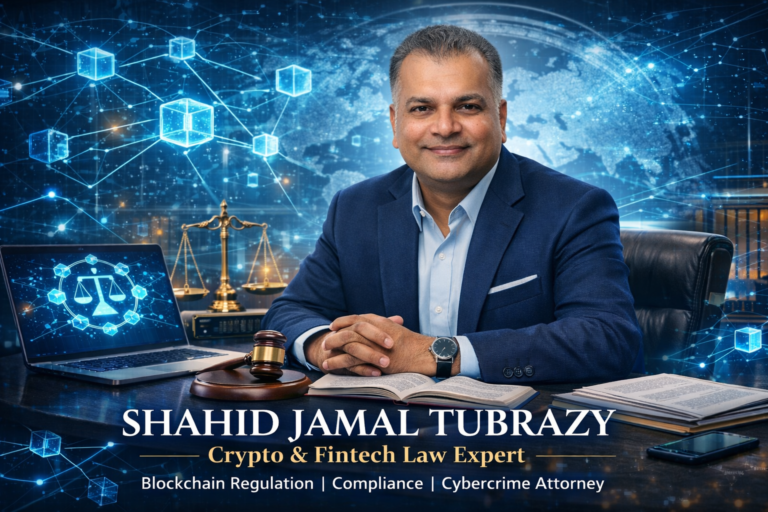
Shahid Jamal Tubrazy (Crypto & Fintech Law Consultant)
Shahid Jamal Tubrazy, a certified top expert in Crypto Law from Duke University, is a leading authority in the cryptocurrency and blockchain space. As a seasoned Fintech lawyer, he offers a full spectrum of services, including licensing, legal guidance for ICOs, STOs, DeFi, and DAOs, as well as specialized expertise in crypto mediation, negotiation, and mergers and acquisitions. With a proven track record and published works on Blockchain Regulation and Cryptocurrency Laws, Shahid provides unparalleled insights into the complexities of the fintech world, ensuring compliance and strategic success. 🌐💼 #CryptoLaw #Fintech #Blockchain #LicenseServices #CryptoMediator #MergersAndAcquisitions #CryptoCompliance #FrozenAssetsrecovery.
EMAIL: shahidtubrazy@gmail.com
Website: https://cyberlawconsult.wixsite.com/cryptolawyer
Facebook: https://www.facebook.com/fintechcryptolawyer