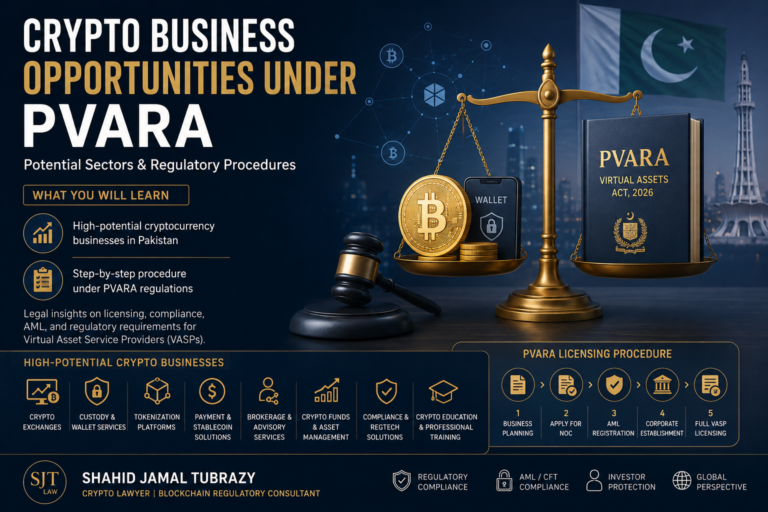
PVARA Minimum Paid-Up Capital Requirements
PVARA Cryptocurrency Licensing Requirements in Pakistan: Minimum Capital for Crypto Exchanges and VASPs
Pakistan’s cryptocurrency regulatory framework has entered a new phase following the introduction of the Virtual Assets Act, 2026 and the establishment of the Pakistan Virtual Asset Regulatory Authority (PVARA). For entrepreneurs planning to establish a cryptocurrency exchange, custody business, broker-dealer, token issuer, investment platform, or another virtual asset enterprise, understanding the PVARA cryptocurrency licensing requirements is now an essential part of regulatory planning.
The Pakistan Virtual Asset Services Regulations, 2026 establish licensing and prudential requirements for Virtual Asset Service Providers (VASPs), including minimum paid-up capital requirements for different categories of virtual asset services. PVARA’s regulatory framework also covers governance, client protection, technology, cybersecurity, operational resilience, risk management and AML/CFT/CPF compliance.
The current PVARA regulatory framework should be read together with the Virtual Assets Act, 2026, the applicable regulations and activity-specific requirements.
For businesses entering Pakistan’s cryptocurrency market, the key question is therefore not simply how much capital is required. It is also which PVARA licence category applies to the proposed cryptocurrency business and what additional regulatory obligations will apply.
Official regulatory resources:
- Pakistan Virtual Asset Regulatory Authority (PVARA)
- PVARA Licensing Framework
- PVARA Regulatory Framework and Regulations
- Virtual Assets Act, 2026
PVARA Cryptocurrency Licence Categories and Minimum Capital
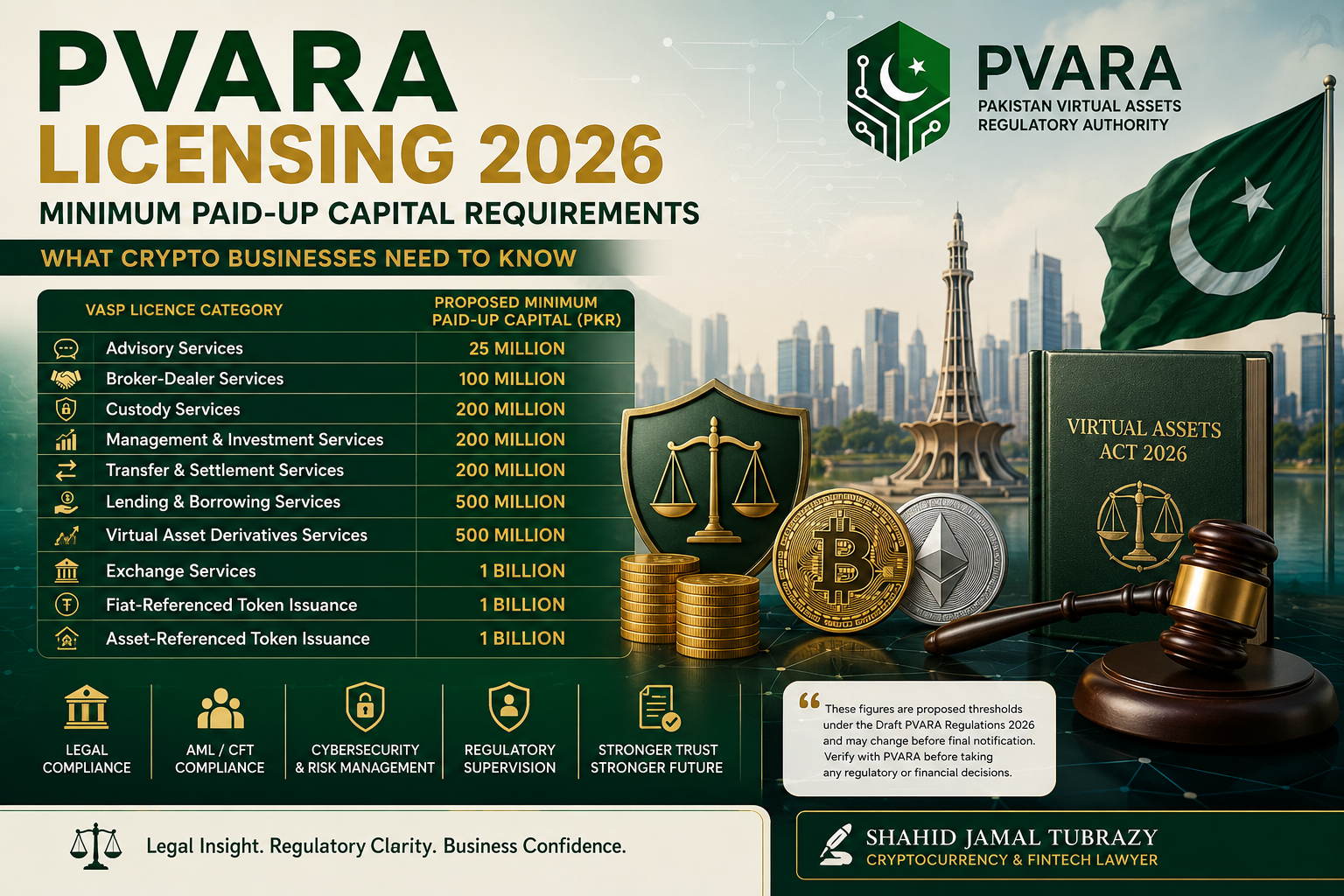
Schedule I of the Pakistan Virtual Asset Services Regulations, 2026 sets out minimum paid-up capital requirements for different categories of Virtual Asset Service Providers.
The published Schedule I provides the following figures:
| PVARA Licence Category | Minimum Paid-Up Capital |
|---|---|
| Advisory Services | PKR 25 million |
| Broker-Dealer Services | PKR 100 million |
| Custody Services | PKR 200 million |
| Virtual Asset Management & Investment Services | PKR 200 million |
| Virtual Asset Transfer & Settlement Services | PKR 200 million |
| Lending & Borrowing Services | PKR 500 million |
| Virtual Asset Derivatives Services | PKR 500 million |
| Exchange Services | PKR 1 billion |
| Fiat-Referenced Token Issuance Services | PKR 1 billion |
| Asset-Referenced Token Issuance Services | PKR 1 billion |
These figures are particularly important for businesses considering cryptocurrency exchange licensing in Pakistan, cryptocurrency custody, token issuance, digital asset investment management and other regulated virtual asset activities.
Because the regulatory framework can develop through amendments, notifications and activity-specific requirements, applicants should verify the applicable requirements directly with PVARA before making significant capital commitments.
PKR 1 Billion Capital Requirement for Cryptocurrency Exchanges
For entrepreneurs planning to establish a cryptocurrency exchange in Pakistan, one of the most important figures is the proposed and now published regulatory threshold of PKR 1 billion in minimum paid-up capital for Exchange Services. Schedule I identifies Exchange Services as requiring PKR 1,000,000,000 in minimum paid-up capital.
PVARA describes Exchange Services as operating a platform for exchanging virtual assets for fiat currency or other virtual assets.
Therefore, a business intending to operate a regulated cryptocurrency exchange should consider its capital structure at the earliest stage of legal and commercial planning.
However, capital is only one part of cryptocurrency exchange licensing.
A prospective exchange should also consider:
- Corporate structure
- Beneficial ownership
- Directors and senior management
- Fit-and-proper requirements
- AML/CFT/CPF controls
- KYC and customer due diligence
- Transaction monitoring
- Cybersecurity
- Wallet and private-key security
- Customer-asset safeguarding
- Asset segregation
- Operational resilience
- Risk management
- Business continuity
- Regulatory reporting
- Banking arrangements
PVARA’s licensing framework specifically identifies fit-and-proper requirements, AML/CFT compliance, cybersecurity and business continuity among the requirements relevant to applicants.
PVARA Advisory Services: PKR 25 Million
The minimum paid-up capital for Advisory Services is PKR 25 million.
This is the lowest capital requirement listed in Schedule I.
PVARA describes Advisory Services as activities involving advice concerning virtual assets, including investment advice, portfolio composition and the merits of particular virtual assets.
This distinction matters because a cryptocurrency business should identify its actual regulated activities before selecting a licence category.
A company that describes itself broadly as a “crypto consultancy” may have a substantially different regulatory profile from a company that executes transactions, holds customer assets, operates an exchange or manages investments.
For that reason, cryptocurrency legal structuring should begin with an analysis of the actual business model.
Broker-Dealer Services: PKR 100 Million
The proposed minimum paid-up capital for Broker-Dealer Services is PKR 100 million.
PVARA describes Broker-Dealer Services as receiving and transmitting orders and dealing in virtual assets on an applicant’s own account or on behalf of clients.
Businesses operating cryptocurrency brokerage platforms should therefore carefully analyze their proposed activities before launching.
The legal analysis should consider whether the business:
- Receives customer orders;
- Executes cryptocurrency transactions;
- Deals on its own account;
- Acts on behalf of customers;
- Transfers virtual assets;
- Holds customer assets; or
- Provides investment or portfolio services.
The answers can affect the applicable licensing and compliance requirements.
Cryptocurrency Custody: PKR 200 Million
The minimum paid-up capital for Custody Services is PKR 200 million.
PVARA defines custody activities around safeguarding, holding or controlling virtual assets or the means of access to them on behalf of clients.
For cryptocurrency custodians, regulatory preparation should go beyond capital.
A custody business should consider its:
- Wallet architecture;
- Private-key management;
- Multi-signature controls;
- Access permissions;
- Internal authorization procedures;
- Customer-asset segregation;
- Incident response;
- Cybersecurity controls;
- Disaster recovery;
- Business continuity;
- Reconciliation procedures.
In practice, cryptocurrency custody creates significant operational and cybersecurity considerations because control over private keys can determine control over the underlying virtual assets.
Virtual Asset Management and Investment Services
The minimum paid-up capital for Virtual Asset Management and Investment Services is PKR 200 million.
This category can be relevant to businesses managing cryptocurrency portfolios or providing structured virtual asset investment services.
Before launching such a business, the founders should establish precisely what the platform will do.
For example, there can be important regulatory differences between:
- Providing general cryptocurrency information;
- Providing personalized investment advice;
- Managing cryptocurrency portfolios;
- Executing transactions for customers; and
- Taking custody of customer assets.
A detailed regulatory classification can therefore prevent the business from building a product around an unsuitable licence category.
Virtual Asset Transfer and Settlement Services
The regulations list PKR 200 million as the minimum paid-up capital for Virtual Asset Transfer and Settlement Services.
This category can be particularly relevant to businesses developing cryptocurrency payment infrastructure, transfer platforms or settlement solutions.
However, businesses should also examine whether their proposed product involves additional activities such as custody, exchange, token issuance or other regulated services.
PVARA has specifically stated that virtual asset services involving issuance, transfer, custody, exchange and related stablecoin or blockchain-based solutions fall within its regulatory framework in applicable circumstances.
Cryptocurrency Lending and Borrowing: PKR 500 Million
The minimum paid-up capital for Lending and Borrowing Services is PKR 500 million.
Cryptocurrency lending businesses should undertake detailed legal and financial analysis before launching their products.
Important issues can include:
- Collateral;
- Loan-to-value ratios;
- Liquidation mechanisms;
- Customer disclosures;
- Counterparty risk;
- Asset custody;
- Interest structures;
- Default procedures;
- Risk management; and
- AML/CFT controls.
The classification of a cryptocurrency lending product should be assessed according to the actual structure rather than its marketing description.
Cryptocurrency Derivatives Services: PKR 500 Million
The minimum paid-up capital for Virtual Asset Derivatives Services is PKR 500 million.
PVARA describes this category as dealing in, arranging or operating a platform for derivatives referencing virtual assets.
Businesses developing cryptocurrency futures, options or other derivative products should therefore conduct a detailed legal review before launch.
Risk management is particularly important because derivatives can create exposure that differs substantially from straightforward cryptocurrency spot transactions.
Token Issuance: PKR 1 Billion
The regulations also provide for PKR 1 billion minimum paid-up capital for:
- Fiat-Referenced Token Issuance Services; and
- Asset-Referenced Token Issuance Services.
This is particularly relevant to cryptocurrency and stablecoin projects.
A token issuer should not assume that satisfying the capital requirement alone completes its regulatory obligations.
The legal structure may also need to address:
- The nature and classification of the token;
- Reserve assets;
- Asset backing;
- Redemption mechanisms;
- Governance;
- Disclosure requirements;
- Customer protection;
- Risk management;
- Custody arrangements; and
- Continuing reporting obligations.
PVARA has also warned that stablecoin initiatives and tokenization structures can fall within its regulatory ambit and has encouraged persons developing such projects to engage with the Authority through the relevant regulatory pathways.
PVARA Capital Requirements Are Only One Part of Licensing
A common misconception in cryptocurrency regulation is that having enough paid-up capital automatically results in a licence.
It does not.
PVARA’s published licensing framework includes several other regulatory requirements. These include fit-and-proper assessments, AML/CFT compliance, cybersecurity and business continuity arrangements.
The broader regulatory framework also addresses:
- Governance;
- Market conduct;
- Client protection;
- Technology;
- Cybersecurity;
- Operational resilience;
- Risk management;
- AML/CFT/CPF;
- Safeguarding of client assets; and
- Segregation of client assets.
Therefore, PVARA licensing should be treated as a complete regulatory project rather than a capital-raising exercise alone.
AML/CFT Compliance for Cryptocurrency Businesses
AML/CFT compliance is a central component of modern cryptocurrency regulation.
The Financial Action Task Force (FATF) has developed standards addressing virtual assets and Virtual Asset Service Providers, including licensing or registration, customer identification, record keeping and suspicious transaction reporting.
In July 2026, FATF published its Seventh Targeted Update on Implementation of the FATF Standards on Virtual Assets and VASPs. The report reviewed global implementation of Recommendation 15 and highlighted continuing regulatory gaps.
FATF reported that 83% of surveyed jurisdictions had passed legislation implementing the Travel Rule, compared with 73% in 2025.
For Pakistani cryptocurrency businesses, this international regulatory environment makes AML/CFT preparation an important part of the business model from the beginning.
A prospective VASP should consider:
- Customer identification;
- Know Your Customer (KYC);
- Know Your Business (KYB);
- Beneficial ownership;
- Transaction monitoring;
- Suspicious activity reporting;
- Sanctions screening;
- Travel Rule compliance;
- Risk-based customer classification;
- Record keeping; and
- Ongoing customer monitoring.
PVARA’s own regulatory framework identifies AML/CFT compliance as a core component of the licensing regime.
PVARA Licensing and Company Incorporation in Pakistan
Corporate structuring is another important element of cryptocurrency licensing in Pakistan.
The Securities and Exchange Commission of Pakistan (SECP) provides the formal company incorporation framework. Its current guidance explains that applicants submit information concerning the proposed company’s directors, subscribers, capital and other corporate credentials.
For a prospective cryptocurrency business, corporate planning should therefore address:
- Company name;
- Shareholding;
- Beneficial ownership;
- Directors;
- Senior management;
- Authorized and paid-up capital;
- Memorandum and Articles of Association;
- Registered office;
- Corporate governance; and
- Regulatory responsibilities.
SECP Company Incorporation Guide
Importantly, PVARA’s current licensing information describes an NOC-to-licence pathway that includes regulatory compliance and local incorporation before the VASP licence stage.
Banking for PVARA-Licensed Cryptocurrency Businesses
Banking access is another significant component of Pakistan’s evolving cryptocurrency regulatory framework.
The State Bank of Pakistan issued BPRD Circular Letter No. 10 of 2026 on April 14, 2026. The circular addresses the opening of bank accounts for PVARA NOC holders, licensed VASPs and their customers, subject to the conditions set out by SBP.
The circular states that SBP-regulated entities may open bank accounts for entities duly licensed by PVARA as VASPs, subject to specified compliance requirements.
This development demonstrates why cryptocurrency regulatory planning should not be conducted in isolation.
A VASP may need to coordinate:
PVARA + SECP + SBP + FMU/AML compliance + corporate law + tax planning + cybersecurity + technology governance
depending on the business model.
State Bank of Pakistan – BPRD Circular Letter No. 10 of 2026
Is the PVARA Cryptocurrency Framework Final?
This question requires an important distinction between the draft consultation stage and the currently notified regulatory framework.
PVARA’s consultation page states that the draft Pakistan Virtual Asset Services Regulations, 2026 were published for consultation and were subject to revision following stakeholder comments.
However, PVARA’s current regulatory page now states that the Pakistan Virtual Asset Services Regulations, 2026 were notified on August 21, 2026 as S.R.O. 1419(I)/2026. It also lists the Pakistan Virtual Asset Services Activity Specific Regulations, 2026 as notified on the same date.
That means an article published today should distinguish between the earlier consultation draft and the regulations that PVARA currently identifies as notified.
For entrepreneurs, the practical lesson is simple:
Always check the latest PVARA notification, regulations and activity-specific requirements before relying on a capital figure or licensing procedure.
Regulatory requirements can change through amendments, further notifications, handbooks and other applicable legal instruments.
PVARA NOC and Licence Process
PVARA currently describes two principal routes toward licensing:
Route 1: Regulatory Sandbox to Licence
Businesses testing innovative virtual asset products can potentially use the regulatory sandbox route.
The process described by PVARA includes:
- Sandbox application.
- Admission to the sandbox.
- Controlled testing.
- Sandbox exit.
- VASP licence application.
Route 2: NOC to Licence
PVARA also describes an NOC-to-licence route.
The published process includes:
- NOC application;
- Issuance of the NOC;
- Completion of applicable regulatory compliance;
- Local incorporation; and
- VASP licence application.
PVARA also states that all VASPs must obtain a formal licence before offering virtual asset services in Pakistan.
What Should a Cryptocurrency Entrepreneur Prepare?
Instead of beginning with the question “How do I obtain a PVARA licence?”, founders should first ask:
“What exactly will my cryptocurrency business do?”
That question determines much of the subsequent regulatory analysis.
A prospective VASP should prepare a regulatory map covering:
- Cryptocurrency business model
- Virtual asset services provided
- Applicable PVARA licence category
- Minimum paid-up capital
- Shareholding structure
- Ultimate beneficial ownership
- Directors and senior management
- Fit-and-proper requirements
- AML/CFT/CPF framework
- KYC and KYB procedures
- Transaction monitoring
- Technology architecture
- Cybersecurity controls
- Customer-asset safeguarding
- Wallet and private-key controls
- Risk management
- Business continuity
- Regulatory reporting
- Banking arrangements
- Corporate and tax requirements
This process can help identify regulatory issues before substantial money is invested in technology, staffing or marketing.
PVARA Cryptocurrency Licensing: Capital Requirements at a Glance
For convenience, the current Schedule I figures can be summarized as follows:
| Cryptocurrency Business | PVARA Minimum Paid-Up Capital |
|---|---|
| Advisory | PKR 25 million |
| Broker-Dealer | PKR 100 million |
| Custody | PKR 200 million |
| Investment Management | PKR 200 million |
| Transfer & Settlement | PKR 200 million |
| Lending & Borrowing | PKR 500 million |
| Derivatives | PKR 500 million |
| Cryptocurrency Exchange | PKR 1 billion |
| Fiat-Referenced Token | PKR 1 billion |
| Asset-Referenced Token | PKR 1 billion |
The figures are derived from Schedule I of the Pakistan Virtual Asset Services Regulations, 2026.
Cryptocurrency Regulation in Pakistan: What Businesses Should Watch
Pakistan’s cryptocurrency regulatory environment is developing rapidly.
The Virtual Assets Act, 2026 establishes PVARA as the authority responsible for licensing, regulation and supervision of virtual assets and VASPs.
At the same time, PVARA’s current framework addresses licensing, AML/CFT compliance, consumer protection, cybersecurity and operational requirements.
Internationally, FATF continues to monitor how jurisdictions implement standards for virtual assets and VASPs. Its 2026 update demonstrates that regulatory implementation remains an international priority.
For businesses considering cryptocurrency operations in Pakistan, this means regulatory planning should be continuous rather than a one-time exercise.
Final Thoughts on PVARA Cryptocurrency Licensing
Pakistan’s PVARA cryptocurrency regulatory framework establishes a structured licensing system for businesses operating in the virtual asset sector.
The current Schedule I capital requirements range from PKR 25 million for Advisory Services to PKR 1 billion for Exchange Services and specified token-issuance activities.
For cryptocurrency exchanges, the PKR 1 billion minimum paid-up capital requirement is particularly significant.
However, paid-up capital is only one component of regulatory readiness. A cryptocurrency business must also consider governance, AML/CFT/CPF compliance, cybersecurity, operational resilience, customer protection, safeguarding and segregation of client assets, risk management and other applicable requirements.
The regulatory environment is also connected to Pakistan’s broader corporate and financial system. SECP governs company incorporation, while SBP’s 2026 banking instructions establish conditions for accounts involving PVARA NOC holders, licensed VASPs and customers.
For entrepreneurs planning to establish a cryptocurrency exchange, crypto custody business, broker-dealer, token issuer, investment platform or other VASP in Pakistan, early legal and regulatory structuring can help identify licensing requirements before significant capital is committed.
The safest approach is to verify the latest PVARA regulations, notifications and activity-specific requirements before incorporating the business, raising capital, launching services or submitting a licence application.
Related Cryptocurrency and Pakistan Regulatory Resources
For further reading, businesses can consult:
- PVARA Official Website
- PVARA Licensing Framework
- PVARA Regulatory Framework
- PVARA Virtual Asset Services Regulations Consultation
- Virtual Assets Act, 2026
- FATF – Virtual Assets and VASPs
- FATF 2026 Virtual Asset/VASP Update
- SECP – Company Registration in Pakistan
- State Bank of Pakistan – BPRD Circular Letter No. 10 of 2026
Disclaimer
The information provided in this article is intended for general informational purposes only and should not be construed as legal, regulatory, investment or financial advice. Cryptocurrency and virtual asset regulations can change, and businesses should verify the latest applicable legislation, regulations, notifications and regulatory guidance before taking action.
Readers should obtain independent professional legal and regulatory advice based on their specific business model, ownership structure, activities and circumstances.
Author & Cryptocurrency Law Consultant
Shahid Jamal Tubrazy – Crypto & Fintech Law Consultant
Shahid Jamal Tubrazy is a cryptocurrency and fintech law professional with specialized certification in Crypto Law from Duke University. He provides legal and regulatory services across the digital asset ecosystem, including cryptocurrency regulatory licensing, ICOs, STOs, DeFi, DAOs, virtual asset businesses, crypto dispute resolution, mediation, negotiation and blockchain-sector mergers and acquisitions.
His work focuses on helping cryptocurrency and fintech businesses understand evolving regulatory frameworks, structure their operations and address legal and compliance challenges in the digital asset industry.
📧 Email: cryptolawyer@cryptolawconsult.com
🌐 Website: https://cryptolawconsult.com/
🔗 LinkedIn: https://www.linkedin.com/in/shahidtubrazy/