
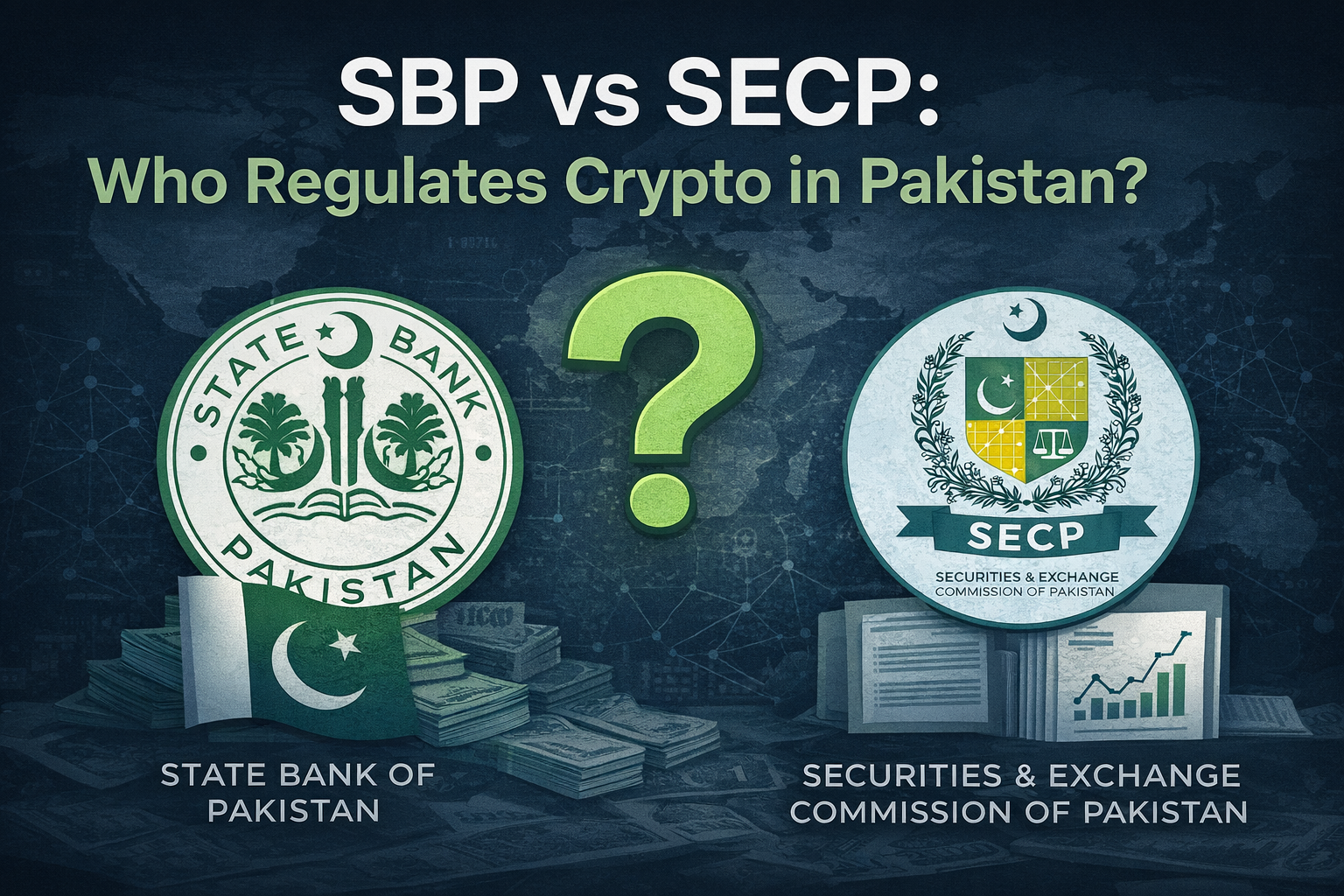
SBP vs SECP: Who Regulates Crypto in Pakistan?
The question of who regulates cryptocurrency in Pakistan—the State Bank of Pakistan (SBP) or the Securities and Exchange Commission of Pakistan (SECP)—remains one of the most misunderstood and legally significant issues in the country’s digital asset landscape.
Role of the State Bank of Pakistan (SBP)
The SBP regulates currency, banking, and payment systems in Pakistan. Historically, SBP has issued circulars cautioning banks and financial institutions against facilitating cryptocurrency transactions. However, SBP does not regulate cryptocurrencies as assets, nor does it license exchanges or crypto businesses. Its authority is limited to:
- Banks and financial institutions
- Payment systems and remittances
- Foreign exchange controls
Importantly, SBP advisories are banking restrictions, not criminal prohibitions on individuals holding or trading crypto.
Role of the Securities and Exchange Commission of Pakistan (SECP)
SECP regulates securities, investment schemes, companies, and capital markets. From a legal perspective, SECP becomes relevant when crypto activities resemble:
- Investment contracts
- Collective investment or pooling schemes
- Token offerings similar to securities
- Crypto-based fraud or Ponzi structures
SECP has repeatedly clarified that crypto assets are not recognized securities, yet it actively investigates fraudulent crypto investment schemes under existing securities and consumer protection laws.
The Legal Reality: A Regulatory Gap
At present, neither SBP nor SECP has issued a comprehensive crypto regulatory framework. This creates a regulatory vacuum where:
- Crypto is not expressly legalized
- Crypto is not expressly criminalized
- Enforcement occurs indirectly through fraud, AML, and banking laws
This ambiguity often leads to account freezes, investigation delays, and jurisdictional confusion, especially in crypto fraud and recovery cases.
Why This Matters for Investors and Victims
In disputes, scams, or frozen accounts, the wrong regulator is often approached, causing loss of time and evidence. A qualified crypto lawyer understands:
- When SBP jurisdiction applies (banking/payment issues)
- When SECP jurisdiction applies (investment fraud, securities-like tokens)
- How to engage FIA, FIUs, and courts where regulatory powers overlap
AI tools or online advice cannot navigate this regulatory overlap or compel cooperation from institutions.
Conclusion
Crypto regulation in Pakistan is currently fragmented and evolving. SBP controls the banking rails; SECP polices investment misconduct—but no single regulator fully governs crypto. Until Pakistan adopts a dedicated digital asset law, legal clarity will depend on professional legal interpretation, not assumptions.
For crypto disputes, fraud recovery, or compliance matters, engaging an experienced crypto lawyer is not optional—it is essential.
The information provided in this article is for general informational purposes only and does not constitute legal or financial advice.
Author & Crypto Consultant
Shahid Jamal Tubrazy (Crypto & Fintech Law Consultant)
Shahid Jamal Tubrazy, a certified top expert in Crypto Law from Duke University, is a leading authority in the cryptocurrency and blockchain space. As a seasoned Fintech lawyer, he offers a full spectrum of services, including licensing, legal guidance for ICOs, STOs, DeFi, and DAOs, as well as specialized expertise in crypto mediation, negotiation, and mergers and acquisitions. With a proven track record and published works on Blockchain Regulation and Cryptocurrency Laws, Shahid provides unparalleled insights into the complexities of the fintech world, ensuring compliance and strategic success. 🌐💼 #CryptoLaw #Fintech #Blockchain #LicenseServices #CryptoMediator #MergersAndAcquisitions #CryptoCompliance #FrozenAssetsrecovery.
EMAIL: shahidtubrazy@gmail.com
Website: https://cyberlawconsult.wixsite.com/cryptolawyer
Facebook: https://www.facebook.com/fintechcryptolawyer





One Comment