Pontes: The ECB’s New Bridge Between Tokenised Finance and Central Bank Money
Pontes and Tokenised Finance in Europe: ECB Central Bank Money, DLT and Crypto Regulation
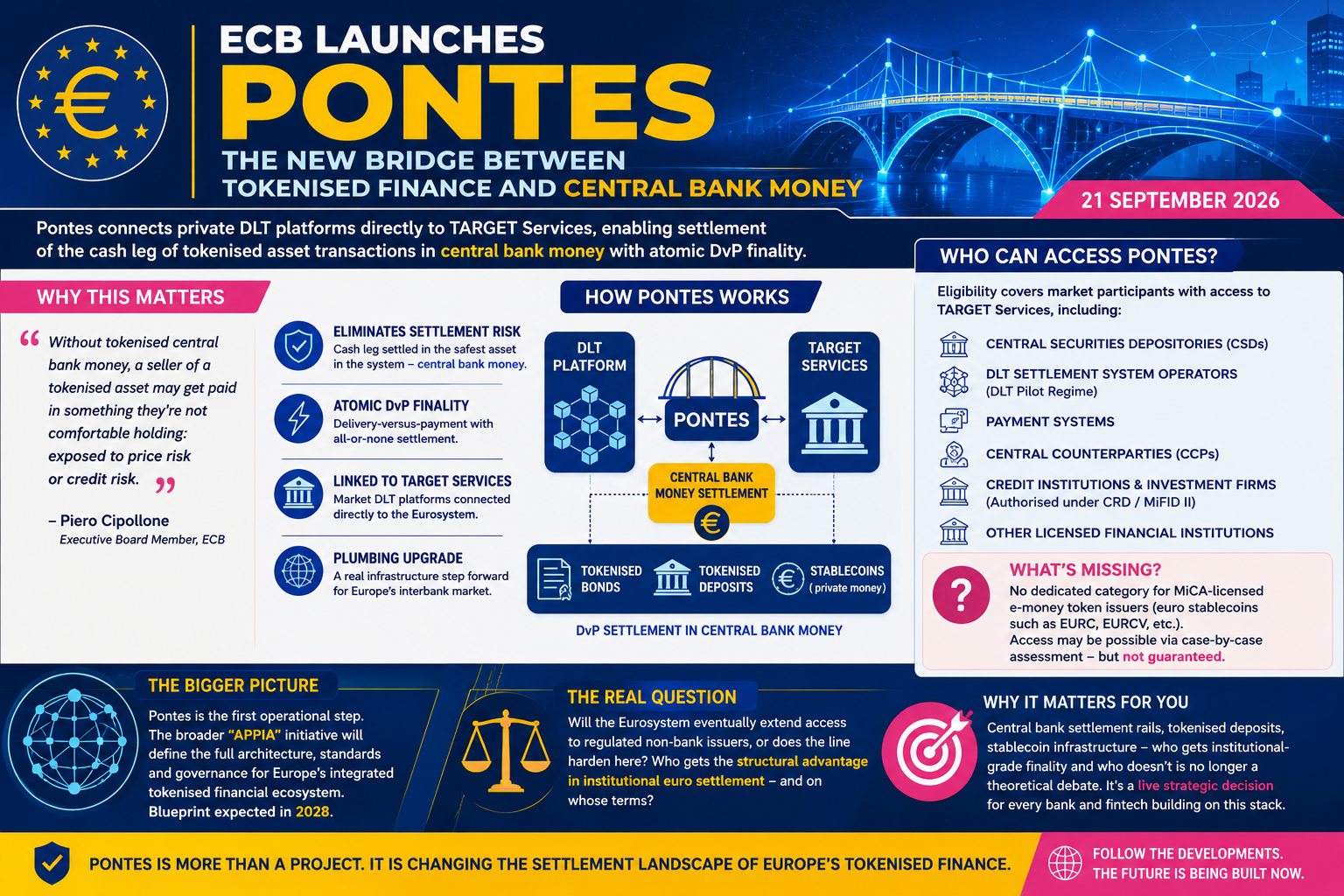
On 21 September 2026, the Eurosystem launched Pontes, a new distributed-ledger technology (DLT) solution designed to settle wholesale tokenised transactions in central bank money.
For banks, fintech companies, digital-asset businesses and institutions working in cryptocurrency regulation and tokenised finance, the launch represents an important development in Europe’s financial-market infrastructure.
Christine Lagarde described Pontes in simple terms as essentially a “digital euro made available for banks.” However, from a crypto law, banking law and financial-market-infrastructure perspective, Pontes is more specific than that description suggests.
Pontes creates a bridge between market DLT platforms and the Eurosystem’s existing TARGET Services, allowing eligible market participants to use central bank money for the cash leg of DLT-based wholesale transactions. The infrastructure is designed to support delivery-versus-payment (DvP) and other transactions that require synchronised settlement.
In practical terms, Pontes is not simply another digital euro initiative.
Instead, it is designed to bring the settlement certainty of central bank money into Europe’s rapidly developing tokenised financial markets.
For businesses involved in blockchain law, cryptocurrency regulation, tokenised securities, stablecoins, DeFi and fintech, understanding this distinction is increasingly important.
What Is Pontes and How Does It Work?
Pontes is part of the Eurosystem’s wider strategy for adapting central bank money and financial-market infrastructure to an increasingly digital financial system.
The core concept is relatively straightforward.
A financial asset can be represented or transferred on a DLT network. For example, a tokenised bond could move between two institutional investors using a blockchain or another distributed-ledger platform.
The problem is the cash leg of the transaction.
If the buyer pays using another private digital asset, commercial-bank money or a stablecoin, the transaction may introduce additional credit, liquidity or counterparty considerations.
Pontes is intended to address that issue by allowing eligible DLT-based transactions to connect with central bank money.
The Eurosystem therefore becomes part of the settlement architecture surrounding tokenised assets.
This is particularly relevant to businesses researching:
- cryptocurrency law in Europe;
- MiCA regulation;
- stablecoin regulation;
- tokenised securities;
- tokenised deposits;
- blockchain financial services;
- digital-asset regulation;
- DLT settlement;
- institutional cryptocurrency;
- European fintech regulation; and
- crypto and fintech legal compliance.
For further background, readers can consult the official European Central Bank material on payments, TARGET Services and digital finance.
Why Central Bank Money Matters for Tokenised Finance
The biggest issue is not whether financial assets can be tokenised.
The financial industry already has significant experience representing securities and other assets through DLT systems.
The harder question is:
What should the seller receive when the tokenised asset changes hands?
This question becomes particularly important for institutional investors.
Suppose a tokenised security is transferred through a DLT platform. The seller needs confidence that the corresponding payment will be safe, final and reliable.
If the payment takes place using a private digital asset, the seller may face additional exposure to:
- price volatility;
- counterparty risk;
- liquidity risk;
- settlement risk;
- credit risk; and
- operational risk.
The European Central Bank has repeatedly highlighted the importance of safe settlement assets when discussing the future of DLT-based financial markets.
Pontes addresses this issue by providing a connection to central bank money.
The objective is therefore not simply to make financial transactions digital.
The objective is to make the cash leg of tokenised transactions compatible with trusted institutional settlement infrastructure.
That distinction is highly relevant to lawyers advising banks, fintech companies, cryptocurrency businesses and digital-asset platforms.
Pontes and Delivery-versus-Payment
One of the most important concepts behind Pontes is delivery-versus-payment, commonly called DvP.
DvP means that the delivery of the financial asset and the corresponding payment are linked so that one does not occur independently of the other.
For example:
Tokenised bond transferred → payment settled → transaction completed
Rather than relying on two disconnected processes, DvP can synchronise the two sides of the transaction.
Pontes is designed to support this type of synchronised settlement between eligible DLT platforms and central bank money.
This could become increasingly important as institutional markets adopt:
- tokenised bonds;
- tokenised funds;
- tokenised equities;
- digital securities;
- blockchain-based financial instruments;
- tokenised deposits; and
- other forms of digital financial assets.
The legal framework surrounding these products can involve several areas simultaneously, including securities law, banking law, payments regulation, DLT regulation and cryptocurrency law.
Pontes Is Not the Retail Digital Euro
One of the most important distinctions is that Pontes should not be confused with the proposed retail digital euro.
The retail digital euro is intended to address everyday digital payments and consumer use.
Pontes, by contrast, is focused on wholesale financial-market settlement.
Its purpose is to connect eligible market DLT platforms with central bank money for institutional transactions.
That means Pontes should be analysed separately from discussions about:
- retail payments;
- consumer digital wallets;
- the digital euro for everyday purchases;
- CBDC adoption by consumers; and
- European payment policy.
The distinction matters because the legal participants, infrastructure and use cases are different.
For cryptocurrency lawyers and fintech advisers, this also means that the digital euro, central bank settlement infrastructure and privately issued crypto-assets should not automatically be treated as the same legal category.
Pontes, Appia and the Future of European Tokenised Finance
Pontes is only one part of the Eurosystem’s broader strategy.
The longer-term Appia initiative is intended to examine the architecture, standards, governance and interoperability required for a more integrated European tokenised financial ecosystem.
The Eurosystem has indicated that the Appia work is expected to develop a broader blueprint for the future architecture.
This creates an important distinction:
Pontes is the operational bridge.
Appia is part of the broader architectural and policy development.
For businesses involved in European crypto regulation and tokenised assets, this distinction is important because the regulatory and technological framework is still developing.
Companies building institutional digital-asset products should therefore avoid assuming that today’s infrastructure represents the final European model.
Who Can Access Pontes?
The legal question becomes particularly important when examining access.
According to the published Eurosystem framework, access is connected to eligibility requirements and access to TARGET.
Eligible market DLT operators can include relevant financial-market infrastructures and other institutions operating under applicable European legal frameworks.
Depending on the relevant framework, the ecosystem can involve:
- central securities depositories;
- DLT settlement systems;
- DLT trading and settlement systems operating under the DLT Pilot Regime;
- payment-system operators;
- central counterparties;
- credit institutions;
- investment firms;
- market operators; and
- other eligible regulated financial institutions.
This creates an important regulatory distinction.
A regulated bank with the appropriate TARGET access is structurally positioned differently from a non-bank digital-asset company.
That distinction matters when analysing MiCA regulation and stablecoin businesses.
Does a MiCA Licence Give a Stablecoin Issuer Pontes Access?
This is one of the most important questions for the European stablecoin market.
A company may be authorised under the Markets in Crypto-Assets Regulation (MiCA) and still not automatically receive direct access to the Eurosystem’s central-bank settlement infrastructure.
A MiCA-regulated stablecoin issuer and a bank with direct access to TARGET do not necessarily occupy the same legal position.
This does not mean that regulated stablecoins are excluded from Europe’s future tokenised financial ecosystem.
Instead, it means that crypto-asset authorisation and central-bank settlement access are separate regulatory questions.
A business considering a euro-denominated stablecoin should therefore examine several different legal layers:
- MiCA authorisation
- Payment and e-money rules where applicable
- Banking and prudential requirements
- TARGET eligibility
- DLT infrastructure requirements
- Securities regulation
- AML and KYC obligations
- Cross-border regulatory requirements
- Settlement finality
- Interoperability with financial-market infrastructure
This is where specialist crypto legal advice can become particularly important.
Businesses can also review the European Union’s official Markets in Crypto-Assets Regulation framework and the European Securities and Markets Authority materials on crypto-asset regulation.
Tokenised Deposits vs Stablecoins
Another important distinction concerns tokenised deposits.
The ECB’s Pontes documentation describes tokenised deposits as commercial-bank liabilities represented as native digital assets on market DLT platforms.
This means a tokenised deposit remains fundamentally different from central bank money.
A simplified comparison is:
| Digital money | Issuer | Legal character |
|---|---|---|
| Central bank money | Central bank | Liability of the central bank |
| Tokenised deposit | Commercial bank | Bank deposit liability |
| Euro stablecoin | Private issuer | Crypto-asset/private settlement asset under applicable law |
This distinction is particularly important for cryptocurrency lawyers, fintech companies and financial institutions designing blockchain-based settlement systems.
A tokenised deposit is a claim against a commercial bank.
A stablecoin is a different legal instrument governed by the applicable regulatory framework.
Neither should automatically be treated as equivalent to central bank money.
For further information about EU financial regulation, businesses should also consult the official European Commission financial-services framework and relevant European Banking Authority guidance.
Could Pontes Change the Role of Stablecoins?
Pontes creates an important policy and market question.
If eligible institutions can settle tokenised transactions using central bank money, what role will privately issued stablecoins play in institutional settlement?
The answer is not necessarily that stablecoins will disappear.
Stablecoins can offer features that central bank settlement infrastructure may not provide in the same way, including:
- programmability;
- DLT-native transfer;
- cross-platform functionality;
- automated transactions;
- 24/7 blockchain-based operations in some environments;
- integration with smart contracts; and
- access to digital-asset ecosystems.
At the same time, institutional users care about:
- settlement finality;
- liquidity;
- counterparty risk;
- legal certainty;
- interoperability;
- regulatory compliance; and
- integration with existing financial infrastructure.
Pontes therefore changes the competitive environment.
The question is not simply:
“Will stablecoins replace central bank money?”
A more useful legal and technological question is:
“Under what legal and technical conditions will stablecoins interoperate with central bank money within Europe’s institutional tokenised-finance infrastructure?”
That question will be particularly relevant to stablecoin issuers, cryptocurrency exchanges, banks, fintech companies and institutional digital-asset platforms.
What Does Pontes Mean for EUR Stablecoins?
The implications may be particularly relevant to euro-denominated stablecoins.
Examples of euro stablecoins and euro-linked digital assets may include products such as EURC and EURCV, although each product must be analysed according to its own issuer, legal structure, authorisation and regulatory status.
A regulated euro stablecoin may provide a DLT-native settlement asset.
Pontes, however, provides a route to central bank money for eligible transactions.
These are different functions.
The future European digital-finance ecosystem may therefore involve several forms of money operating alongside each other:
Central bank money + tokenised deposits + regulated stablecoins + tokenised financial assets
The legal challenge will be determining how these different forms of value interact.
That will require careful analysis of MiCA, banking regulation, payment law, securities regulation, settlement law and DLT regulation.
Pontes and the MiCA Regulatory Framework
The launch of Pontes should also be considered alongside the development of the European Union’s broader crypto-asset regulatory framework.
MiCA established a harmonised framework for certain crypto-assets and crypto-asset service providers within the European Union.
However, MiCA does not replace every other area of financial regulation.
A digital-asset business may need to consider multiple regulatory regimes depending on its activities.
For example, a business operating a tokenised financial product could potentially face questions involving:
- MiCA;
- securities law;
- banking regulation;
- payment services;
- AML requirements;
- consumer protection;
- data protection;
- DLT market infrastructure;
- settlement finality; and
- cross-border financial regulation.
This is why crypto law in Europe is increasingly becoming an intersection of multiple legal disciplines rather than a standalone regulatory category.
What Pontes Means for Banks and Fintech Companies
For banks, Pontes may create new opportunities to participate in institutional tokenised markets while maintaining a connection to central bank settlement.
Financial institutions should consider how the infrastructure could affect:
- tokenised securities;
- wholesale payments;
- tokenised deposits;
- securities settlement;
- collateral management;
- digital bonds;
- blockchain-based financial products;
- institutional stablecoin settlement; and
- cross-platform DvP.
Fintech companies should also consider the regulatory perimeter before building products that depend on access to institutional settlement infrastructure.
A technically functional blockchain product may still face significant legal questions concerning licensing, custody, settlement, payments, securities and market infrastructure.
What Pontes Means for Stablecoin Issuers
Stablecoin issuers should pay particular attention to the distinction between being regulated and having direct access to central-bank infrastructure.
A regulatory licence can establish that a business operates within a recognised legal framework.
It does not necessarily mean that the business receives every form of financial-market infrastructure access available to banks or other eligible institutions.
Stablecoin issuers should therefore examine:
- their authorisation status;
- the legal classification of their token;
- reserve requirements;
- redemption arrangements;
- banking relationships;
- settlement partners;
- DLT connectivity;
- TARGET eligibility;
- custody arrangements;
- AML obligations; and
- interoperability with institutional financial infrastructure.
These questions will become increasingly relevant as European financial markets move toward tokenisation.
Key Legal Questions Created by Pontes
From a crypto law and fintech regulation perspective, Pontes creates several questions that financial institutions and digital-asset businesses should already be examining.
1. Who qualifies for direct access to Pontes?
Businesses should determine whether they qualify directly or must work through an eligible institution.
2. Which DLT platforms can connect to Pontes?
The technical connection is also a legal and regulatory question because different DLT infrastructures operate under different regulatory frameworks.
3. How will tokenised deposits interact with central bank money?
Banks developing tokenised deposits will need to understand how commercial-bank money interacts with central-bank settlement.
4. How will MiCA-regulated stablecoins interact with the Eurosystem?
Stablecoin issuers should examine whether their products can participate indirectly or directly in institutional settlement arrangements.
5. What legal structure will support DvP?
Tokenised securities transactions require more than blockchain technology. The legal enforceability of the transaction and settlement process also matters.
6. How will securities law and MiCA interact?
Not every digital asset is regulated solely under MiCA. The legal classification of an asset can determine which regulatory framework applies.
7. Will non-bank issuers receive clearer infrastructure access?
The future European framework may continue to develop as tokenised markets expand.
8. What role will stablecoins play?
Stablecoins may remain useful as private digital settlement assets even as central bank money becomes more accessible to institutional DLT markets.
Pontes and the Future of Institutional Cryptocurrency
The significance of Pontes extends beyond the technology itself.
It represents a shift in how European institutions are approaching institutional cryptocurrency and blockchain finance.
Instead of treating DLT-based financial markets as completely separate from traditional financial infrastructure, the Eurosystem is developing mechanisms that connect the two.
That could support a more integrated model in which:
Traditional financial infrastructure + DLT + tokenised assets + central bank money
operate together.
For the cryptocurrency industry, this is important because institutional adoption depends not only on blockchain technology.
It also depends on:
- legal certainty;
- settlement finality;
- regulatory compliance;
- financial-market infrastructure;
- institutional trust;
- liquidity; and
- interoperability.
Pontes Is the Beginning, Not the Final Architecture
The launch of Pontes should not be interpreted as the final European framework for tokenised finance.
The Eurosystem’s broader Appia initiative is intended to explore the architecture, standards, governance, interoperability and legal framework required for an integrated European tokenised financial ecosystem.
Pontes is therefore an important operational step.
However, the broader legal architecture is still developing.
For banks, stablecoin issuers, fintech companies and cryptocurrency businesses, this means that regulatory planning should account for future developments rather than relying exclusively on the infrastructure available today.
Businesses building products for European institutional markets should monitor developments from the:
- European Central Bank
- European Commission
- European Securities and Markets Authority
- European Banking Authority
- European System of Central Banks
These sources provide important information for anyone researching European crypto regulation, MiCA, DLT, tokenised finance and digital-asset law.
What Banks, Fintechs and Crypto Businesses Should Watch
The next stage of Europe’s tokenised financial ecosystem will likely require businesses to monitor several areas simultaneously.
These include:
- central-bank settlement infrastructure;
- DLT market infrastructure;
- MiCA implementation;
- stablecoin regulation;
- tokenised deposits;
- securities tokenisation;
- digital bonds;
- DvP mechanisms;
- TARGET Services;
- Appia;
- financial-market interoperability;
- settlement finality; and
- cross-border digital-asset regulation.
For legal advisers and compliance teams, these developments demonstrate why crypto law and fintech law increasingly overlap with traditional banking and securities regulation.
Conclusion: Pontes Changes the Settlement Conversation
The launch of Pontes represents an important development in Europe’s tokenised financial markets.
Its significance is not simply that the Eurosystem has introduced another digital form of the euro.
The more important development is that the Eurosystem has begun connecting private DLT market infrastructure with central bank money.
For tokenised securities, this can address one of the fundamental questions surrounding institutional adoption:
How can the cash leg of a blockchain-based financial transaction achieve the same level of confidence associated with traditional central-bank settlement?
For banks and eligible financial-market infrastructures, Pontes provides an operational route toward that objective.
For stablecoin issuers and other non-bank digital-asset businesses, however, an important legal question remains:
How will regulated private digital money ultimately interact with Europe’s central-bank settlement infrastructure?
The ECB has indicated that stablecoins and tokenised deposits can coexist with central bank money. At the same time, the broader Appia initiative is expected to continue examining the architecture needed for a more integrated tokenised financial ecosystem.
Therefore, Pontes should not be viewed simply as another payment technology.
It is part of a much larger transformation involving cryptocurrency regulation, blockchain finance, tokenised securities, stablecoins, banking law, securities law and financial-market infrastructure.
For every bank, fintech company, stablecoin issuer, DLT operator and digital-asset business targeting European institutional markets, one question deserves particular attention:
Who will have access to Europe’s safest settlement asset — and under what legal conditions?
Disclaimer
The information provided in this article is intended for general informational purposes only and should not be construed as legal, financial, investment or regulatory advice. Cryptocurrency and financial-market regulation can change rapidly. Readers should obtain independent professional legal advice tailored to their specific circumstances before making regulatory, financial or business decisions.
Author & Crypto Law Consultant
Shahid Jamal Tubrazy – Crypto & Fintech Law Consultant
Shahid Jamal Tubrazy is a professional in the field of cryptocurrency and blockchain law, with specialized certification in Crypto Law from Duke University. He provides legal and regulatory services across the digital-asset ecosystem, including cryptocurrency regulation, fintech law, ICOs, STOs, DeFi, DAOs, digital-asset disputes, mediation, negotiation and blockchain-sector mergers and acquisitions.
His work focuses on helping businesses understand complex developments in crypto regulation, blockchain law, fintech compliance, digital assets and cryptocurrency disputes.
For cryptocurrency legal services and regulatory consultation, visit Crypto Law Consult.
📧 Email: cryptolawyer@cryptolawconsult.com
🌐 Website: https://cryptolawconsult.com/
🔗 LinkedIn: https://www.linkedin.com/in/shahidtubrazy/