Why the CLARITY Act Failed and What It Means for the Future of Cryptocurrency
Cryptocurrency Regulation: What the CLARITY Act Failure Means
The United States has spent years trying to answer one fundamental question about cryptocurrency regulation: what rules apply to digital assets, and which federal regulator has jurisdiction?
The Digital Asset Market CLARITY Act of 2025, H.R. 3633, was designed to provide a statutory framework for answering those questions.
The House of Representatives passed the legislation in 2025. In May 2026, the Senate Banking Committee also advanced the bill by a 15–9 vote after bipartisan negotiations.
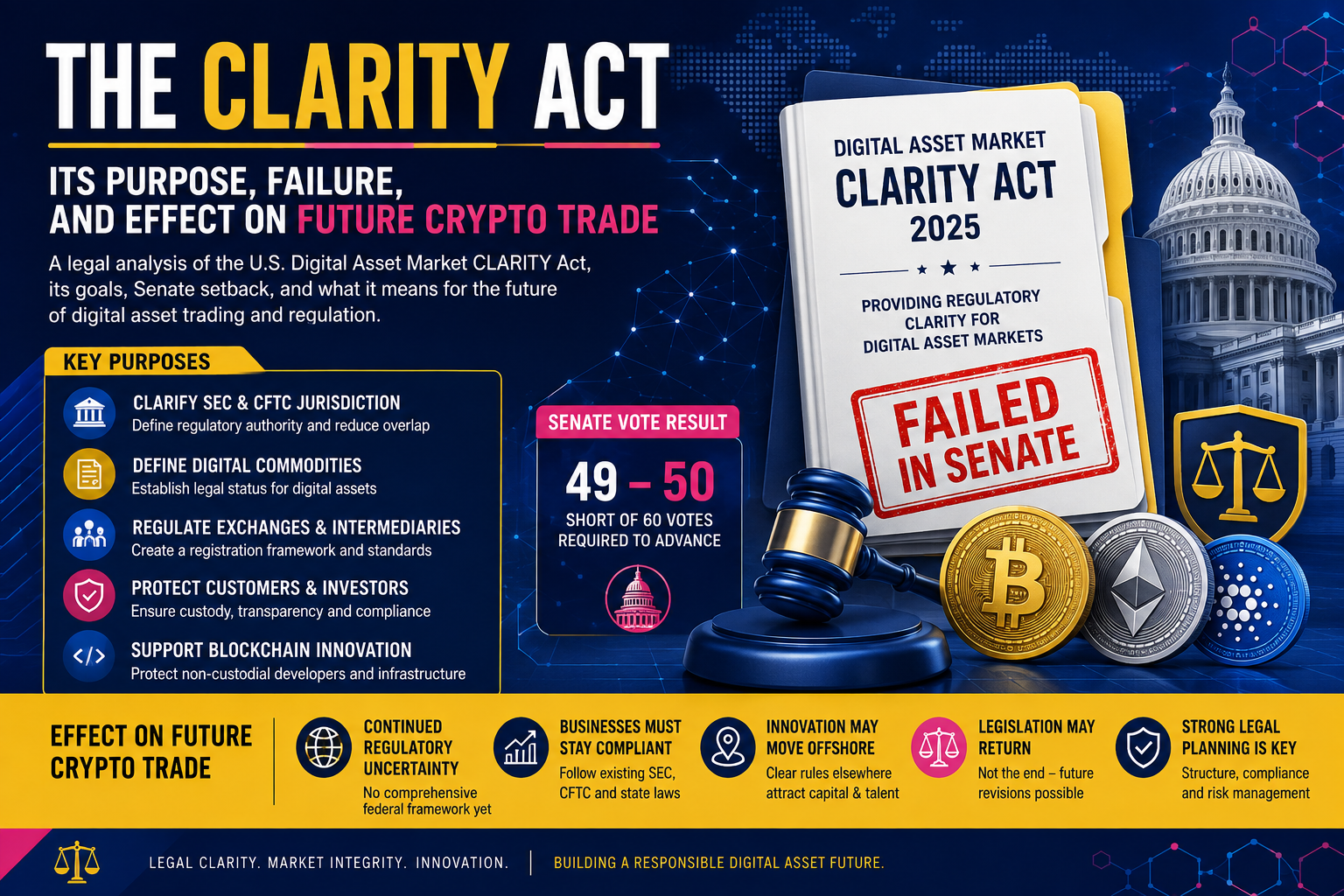
However, on September 15, 2026, the U.S. Senate failed to invoke cloture on the motion to proceed to H.R. 3633. The recorded vote was 49–50, falling short of the 60 votes required to advance the measure.
For the cryptocurrency industry, this is an important regulatory development. However, it does not mean that cryptocurrency trading has become illegal in the United States.
It also does not necessarily mean that the CLARITY Act can never return.
Instead, the vote means that the proposed federal market-structure framework has, for now, failed to clear an important Senate procedural hurdle.
What Is the CLARITY Act?
The CLARITY Act—formally the Digital Asset Market Clarity Act of 2025—was intended to create a comprehensive federal framework for digital assets.
The House version addressed areas including:
- definitions for digital commodities;
- regulatory jurisdiction;
- registration of digital-asset exchanges, brokers and dealers;
- digital assets originating from investment contracts;
- secondary-market transactions;
- customer protection;
- application of the Bank Secrecy Act; and
- treatment of certain non-controlling blockchain developers.
The original House text specifically included provisions concerning expedited registration for digital commodity exchanges, brokers and dealers, as well as provisions concerning non-controlling blockchain developers.
The central objective was relatively straightforward:
A cryptocurrency business should be able to determine which regulator has jurisdiction, what registration requirements apply, and what conduct is permitted.
That issue has remained central to U.S. cryptocurrency regulation because digital assets do not always fit neatly into traditional categories such as securities and commodities.
Why Was the CLARITY Act Important for Cryptocurrency Regulation?
The legislation addressed several areas that have created uncertainty for cryptocurrency businesses.
1. Clarifying SEC and CFTC Jurisdiction
One of the principal objectives was to establish clearer boundaries between the Securities and Exchange Commission (SEC) and the Commodity Futures Trading Commission (CFTC).
The Senate Banking Committee described the legislation as an effort to establish clearer rules for digital assets, while the House version contained provisions defining digital commodities and their regulatory treatment.
This distinction matters because classification can affect:
- registration;
- disclosure;
- trading;
- custody;
- reporting;
- compliance; and
- enforcement obligations.
For a cryptocurrency company, uncertainty over jurisdiction can therefore affect both legal risk and business planning.
2. Creating a Digital Commodity Framework
The CLARITY Act sought to establish a statutory category for digital commodities.
This could be particularly relevant to blockchain networks where a token has a functional role within an operating network rather than simply representing a traditional investment security.
The House text included specific definitions and provisions dealing with digital commodities and their offers and sales.
For cryptocurrency projects, this distinction could have significant consequences because the legal treatment of a token can depend on the structure of the network, the transaction, the parties involved and the way the asset is offered.
3. Establishing Rules for Cryptocurrency Exchanges and Intermediaries
The proposed framework also contemplated federal registration requirements for digital-asset exchanges, brokers and dealers.
The House version included expedited registration provisions for digital commodity exchanges, brokers and dealers.
For cryptocurrency businesses, a defined registration framework could provide greater predictability than attempting to determine which existing financial-law regime applies to each activity.
4. Strengthening Customer Protection
The legislation also addressed customer-protection requirements for regulated digital-asset businesses.
These issues can include:
- custody of customer assets;
- recordkeeping;
- compliance systems;
- operational controls;
- segregation and protection of assets; and
- regulatory oversight.
Consequently, cryptocurrency exchanges and other intermediaries would need to consider not only whether an activity is permitted, but also how customer assets and information are handled.
5. Addressing Blockchain Developers
Another important issue was the treatment of certain non-controlling blockchain developers and infrastructure providers.
The House bill included a provision specifically addressing certain non-controlling blockchain developers.
This reflects a broader legal question in cryptocurrency regulation:
Should a person who writes software or contributes to an open blockchain automatically be treated like a traditional financial intermediary?
The answer may depend on whether that person controls customer assets, provides intermediary services or exercises meaningful control over the financial activity.
The CLARITY Act attempted to create statutory distinctions around these activities.
Why Did the CLARITY Act Fail to Advance?
The September 15 Senate vote should be described carefully.
The Senate did not hold a final vote rejecting the entire CLARITY Act.
Instead, senators voted on cloture on the motion to proceed to H.R. 3633. The motion received 49 votes in favor and 50 against, meaning the required 60 votes were not obtained.
Therefore, the vote was a procedural failure to advance the legislation rather than a final determination that cryptocurrency regulation should not be enacted.
The reasons for opposition included both political and substantive disagreements.
Democratic senators raised concerns about ethics and conflicts of interest involving cryptocurrency interests. Other disagreements involved stablecoin rewards, banking interests, consumer protection and the structure of the proposed regulatory framework.
Four Republican senators also voted against advancing the measure, showing that the opposition was not exclusively along party lines.
Accordingly, it would be too simplistic to describe the vote merely as a disagreement about whether cryptocurrency should be regulated.
A more precise description is that Congress has not yet reached sufficient consensus on the structure of a comprehensive federal digital-asset market framework.
Is the CLARITY Act Dead?
Not necessarily.
The September 15 vote represents a significant setback, but a failure to invoke cloture is different from permanently terminating the legislation.
The Senate record shows that Senator Thom Tillis subsequently moved to reconsider the cloture vote.
That means the legislative path has not necessarily disappeared completely.
At the same time, cryptocurrency businesses should not assume that the CLARITY Act will immediately become law.
The practical position is therefore continued uncertainty.
What Happens to Cryptocurrency Regulation Now?
This may be the most important consequence for cryptocurrency businesses.
Without a comprehensive federal market-structure statute, cryptocurrency regulation will continue to develop through a combination of:
- SEC rules and enforcement actions;
- CFTC rules and enforcement actions;
- existing federal securities and commodities laws;
- banking requirements;
- anti-money-laundering requirements;
- state cryptocurrency and money-transmission laws;
- court decisions;
- agency interpretations and guidance; and
- future congressional legislation.
Following the Senate setback, industry and regulatory attention has increasingly turned toward what the SEC and CFTC can do under their existing statutory authority.
This means cryptocurrency regulation does not stop simply because the CLARITY Act failed to advance.
U.S. Cryptocurrency Exchanges
U.S.-based cryptocurrency exchanges may continue operating under the existing combination of federal and state requirements.
However, without a comprehensive market-structure statute, businesses may face greater difficulty determining which regulatory framework applies to particular products and services.
This can affect decisions involving:
- token listings;
- custody;
- brokerage;
- trading platforms;
- staking;
- derivatives;
- stablecoins; and
- decentralized trading infrastructure.
Cryptocurrency Token Issuers
Token issuers will continue to face classification questions.
A project should not analyze only the token itself.
Instead, legal analysis should consider the entire structure, including:
- how the token is issued;
- how it is distributed;
- how it is marketed;
- the rights attached to the token;
- the governance structure;
- the development of the underlying network;
- the role of founders and promoters; and
- the activities of affiliated companies.
The failure of the CLARITY Act does not create a blanket exemption for cryptocurrency token issuers.
Institutional Cryptocurrency Trading
Institutional participation in cryptocurrency markets is also closely connected to regulatory certainty.
Banks, asset managers, exchanges, custodians and other financial institutions generally need clarity concerning:
- custody;
- market infrastructure;
- compliance responsibilities;
- asset classification;
- reporting;
- risk management; and
- licensing.
A comprehensive statutory framework could provide greater predictability. In its absence, institutions must continue working within existing regulatory permissions and structures.
Cryptocurrency and DeFi
Decentralized finance presents an even more complicated legal problem.
A:
- protocol developer;
- governance participant;
- interface provider;
- validator;
- liquidity provider; and
- centralized intermediary
may have materially different legal roles.
The CLARITY Act’s provisions concerning non-controlling blockchain developers were therefore significant.
Without the legislation advancing, these questions remain dependent on existing law, agency interpretation, judicial decisions and future congressional action.
Could the CLARITY Act Failure Push Cryptocurrency Businesses Offshore?
Regulatory uncertainty is one of the issues frequently raised in discussions about the international competitiveness of the U.S. cryptocurrency industry.
At a July 2026 House hearing, witnesses and lawmakers discussed concerns about innovation and capital moving toward jurisdictions including the European Union, United Kingdom, Hong Kong, Singapore and the United Arab Emirates.
Those statements should be understood as industry and congressional views rather than as a definitive finding that every cryptocurrency company will move offshore.
Nevertheless, jurisdiction remains an important consideration when structuring an international cryptocurrency business.
A project may need to analyze:
- where the operating company is incorporated;
- where founders and management are located;
- where customers are located;
- where tokens are offered;
- where cryptocurrency custody occurs;
- which entities control customer assets;
- which financial services are provided;
- AML and KYC obligations;
- sanctions requirements;
- tax exposure; and
- licensing requirements.
For businesses operating internationally, U.S. market access should not be assumed merely because a company is incorporated outside the United States.
What Does the CLARITY Act Failure Mean for Global Cryptocurrency Markets?
The CLARITY Act is U.S. legislation, so its failure does not directly determine the legal status of cryptocurrency trading in Pakistan, the European Union, the United Kingdom, the UAE, Singapore or other jurisdictions.
However, U.S. cryptocurrency regulation has international significance.
The United States remains a major financial and technology market. Consequently, rules affecting U.S. exchanges, token issuers, custodians, stablecoins and institutional participants can influence international cryptocurrency market structures.
For international cryptocurrency businesses, the key issue is therefore market-specific legal analysis.
A foreign virtual-asset service provider or cryptocurrency company entering the United States must independently evaluate applicable federal and state requirements.
Similarly, a U.S.-focused cryptocurrency business expanding into another jurisdiction must analyze that jurisdiction’s own licensing, AML, tax and consumer-protection requirements.
What Should Cryptocurrency Businesses Do Now?
The Senate’s procedural vote does not eliminate the need for compliance.
Instead, cryptocurrency companies should continue reviewing their regulatory structures under currently applicable law.
1. Classify the Business Activity
Do not analyze only the token.
Analyze the complete business model.
An exchange, broker, custodian, payment provider, software developer and DeFi protocol can present very different legal questions.
2. Identify Every Relevant Jurisdiction
Customer location, entity location, management location, custody location and service location can all affect regulatory obligations.
A cryptocurrency company operating internationally should map these jurisdictions before launching new products.
3. Review Licensing Requirements
A business providing:
- exchange services;
- brokerage;
- custody;
- transfers;
- payments;
- stablecoin services; or
- other financial services
may require a different legal analysis from a software-only blockchain project.
4. Strengthen AML and KYC Controls
Regulatory uncertainty does not eliminate anti-money-laundering, sanctions or financial-crime risks.
Cryptocurrency businesses should therefore maintain appropriate compliance systems and regularly review them against the jurisdictions in which they operate.
5. Review Cryptocurrency Token Documentation
Whitepapers, token-sale agreements, SAFTs, terms of service, risk disclosures and marketing materials should accurately reflect the project’s actual legal structure.
Inconsistent documentation can create additional regulatory and litigation risks.
6. Prepare for Future Regulatory Change
Cryptocurrency businesses should build compliance systems that can adapt when legislation, agency rules or judicial interpretations change.
This is particularly important while Congress considers future digital-asset legislation.
The Future of Cryptocurrency Regulation: Congress or Federal Agencies?
The failure of the CLARITY Act may result in a period where federal agencies continue developing cryptocurrency rules under their existing statutory powers.
That approach can provide practical guidance, but agency action is not identical to legislation enacted by Congress.
Agency rules can be challenged in court and can potentially change with future administrations.
A statute enacted by Congress provides a different and generally more durable legal foundation.
That distinction matters particularly for long-term investments in:
- cryptocurrency exchanges;
- custodians;
- tokenization platforms;
- stablecoin infrastructure;
- blockchain networks; and
- institutional digital-asset services.
For these businesses, regulatory certainty can affect investment decisions, product design and compliance costs.
What Does the Senate Vote Mean for the Future of Cryptocurrency?
The most immediate consequence of the September 15 vote is continued uncertainty surrounding comprehensive U.S. cryptocurrency market-structure legislation.
The vote did not prohibit cryptocurrency trading.
It did not eliminate existing federal cryptocurrency laws.
It did not prevent the SEC or CFTC from continuing to exercise their existing statutory authority.
And it did not necessarily prevent Congress from considering digital-asset legislation again.
Instead, the vote leaves cryptocurrency businesses operating within an existing regulatory environment while lawmakers and regulators continue debating how that framework should evolve.
For lawyers, compliance officers and cryptocurrency entrepreneurs, the practical lesson is straightforward:
Do not build a business model on the assumption that the CLARITY Act will soon become law.
Instead, businesses should structure their operations around currently applicable law, monitor SEC and CFTC developments, maintain strong compliance systems and remain prepared to modify their structures if Congress eventually establishes a comprehensive digital-asset market framework.
Cryptocurrency Regulation and the Road Ahead
The CLARITY Act may return in another form or during another legislative session.
For now, however, cryptocurrency businesses must continue operating within the laws and regulations currently applicable to their activities.
The next phase of U.S. cryptocurrency regulation could therefore involve a combination of congressional negotiations, federal agency rulemaking, enforcement actions, judicial decisions and state-level regulation.
For international businesses, the situation also reinforces the importance of conducting jurisdiction-by-jurisdiction legal due diligence.
Ultimately, the future of cryptocurrency regulation in the United States will depend not on a single Senate vote, but on how Congress, federal agencies and the courts develop the legal framework governing digital assets.
Until then, regulatory due diligence remains essential for cryptocurrency exchanges, token issuers, blockchain developers, DeFi projects, custodians, investors and other participants in the digital-asset ecosystem.
Related Cryptocurrency Legal Resources
- [Internal link: Cryptocurrency Licensing in Pakistan] — Explain the current licensing and regulatory environment for cryptocurrency businesses in Pakistan.
- [Internal link: Pakistan’s Stablecoin Future Under PVARA] — Discuss Pakistan’s emerging virtual-asset regulatory framework and stablecoin developments.
- [Internal link: Ultimate Cryptocurrency Scam Recovery Guide] — Explain legal options for victims seeking recovery of stolen cryptocurrency.
- [Internal link: Cryptocurrency Law and Regulatory Services] — Link to your main legal-services page.
- [Internal link: Cryptocurrency Books & Resources] — Link to your
/booksresource section.
Disclaimer
This article provides general legal commentary and is intended for informational purposes only. It does not constitute legal or financial advice for any particular cryptocurrency project, token, exchange, investor or transaction.
U.S. federal and state digital-asset laws can vary depending on the facts, business model, transaction structure and jurisdiction. Readers should obtain independent professional legal advice regarding their specific circumstances.
Author & Cryptocurrency Law Consultant
Shahid Jamal Tubrazy – Crypto & Fintech Law Consultant
Shahid Jamal Tubrazy is a cryptocurrency and fintech law consultant with specialized certification in Crypto Law from Duke University. He provides legal services across the digital-asset ecosystem, including regulatory licensing, legal structuring for ICOs, STOs, DeFi projects and DAOs.
His practice also covers cryptocurrency dispute resolution, mediation, negotiation and mergers and acquisitions within the blockchain sector.
Through published analysis of cryptocurrency regulation, blockchain law and emerging digital-asset frameworks, Shahid provides practical legal insights for businesses and clients navigating complex regulatory environments.
His work focuses on helping clients understand regulatory obligations, structure digital-asset businesses and respond to the rapidly evolving legal landscape surrounding cryptocurrency and fintech.
Email: cryptolawyer@cryptolawconsult.com
Website: cyberlawconsult.wixsite.com/cryptolawyer
Facebook: facebook.com/fintechcryptolawyer
LinkedIn: linkedin.com/in/tubrazyfintechlawyer/