Pakistan Opens Cryptocurrency Licensing Portal
Pakistan has now moved from creating a legal framework for virtual assets to the implementation and enforcement stage.
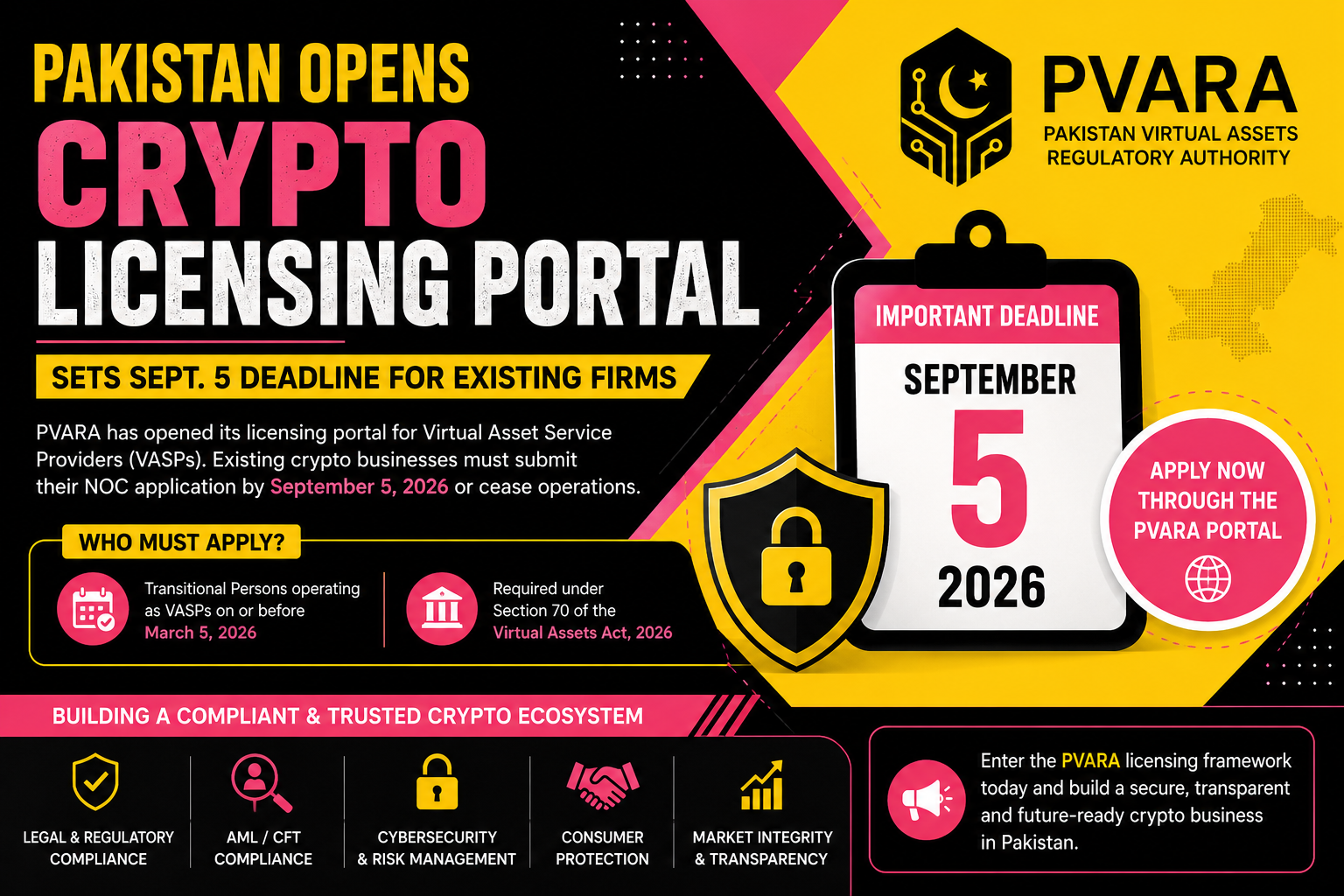
The Pakistan Virtual Assets Regulatory Authority (PVARA) has opened its licensing portal and is requiring existing virtual asset businesses covered by the transitional provisions of the Virtual Assets Act, 2026 to submit a No Objection Certificate (NOC) application by September 5, 2026, or cease their operations.
For cryptocurrency exchanges, custodians, broker-dealers, token businesses and other Virtual Asset Service Providers (VASPs), this is not simply another regulatory announcement. It represents a fundamental change in the legal position of businesses operating in or serving the Pakistani virtual asset market.
September 5, 2026 Is the Critical Deadline
PVARA identifies businesses that were operating as virtual asset service providers on or before March 5, 2026 as “Transitional Persons.” These businesses must submit an NOC application by September 5, 2026 or cease operations, as required under Section 70 of the Virtual Assets Act, 2026.
The legal significance of the deadline should not be underestimated.
An existing crypto business should not assume that simply having operated in Pakistan before the Act came into force provides continuing authorization. The transitional framework requires the business to enter the formal regulatory process.
In practical terms, the September 5 deadline should be treated as a regulatory filing deadline, not merely a future licensing deadline.
What Is PVARA?

The Virtual Assets Act, 2026 established PVARA as Pakistan’s dedicated federal authority for licensing, supervising and regulating virtual assets and Virtual Asset Service Providers. The stated objectives include consumer protection, transparency, market integrity and combating money laundering, terrorist financing and other illicit activities involving virtual assets.
The legislation applies to VASPs carrying on, or holding themselves out as carrying on, virtual asset services in or from Pakistan, as well as certain virtual asset issuers.
This means that businesses need to examine not only where they are incorporated, but also how and where they conduct their virtual asset activities.
The NOC Is the Gateway to Full Licensing
Under the Virtual Assets Act, a person intending to incorporate a company for the primary purpose of engaging in virtual asset services must first apply to PVARA for an NOC before commencing the incorporation process.
PVARA’s current licensing pathway describes the process as:
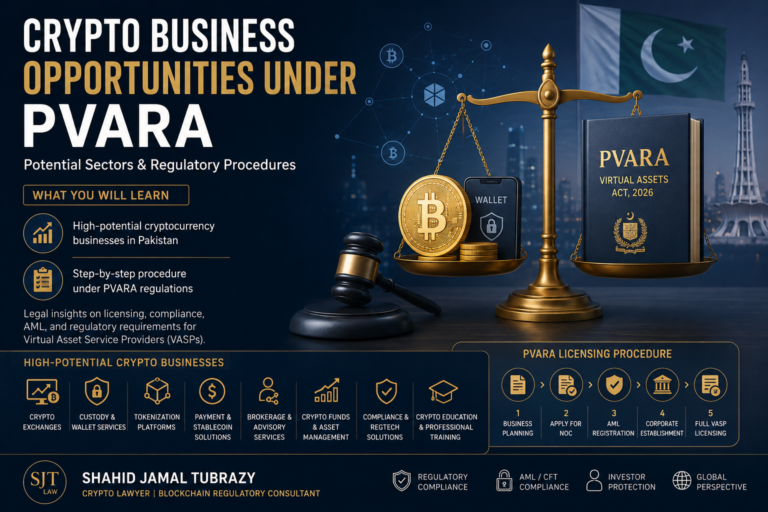
NOC application → NOC issuance → regulatory compliance → local incorporation → VASP licence.
Therefore, an NOC should not be confused with a full VASP licence. It is an important regulatory stage through which the applicant progresses toward full authorization.
What Existing Crypto Businesses Should Do Now
An existing crypto business should immediately undertake a regulatory gap assessment.
At a minimum, management should identify:
- The exact virtual asset services being provided.
- The appropriate PVARA licence category.
- Corporate ownership and beneficial ownership.
- Directors and senior management.
- AML/CFT/CPF arrangements.
- KYC and KYB procedures.
- Customer-asset safeguarding arrangements.
- Cybersecurity controls.
- Technology infrastructure.
- Risk-management framework.
- Business continuity arrangements.
- Regulatory reporting requirements.
- Pakistani corporate and tax obligations.
PVARA’s licensing framework covers multiple categories, including advisory services, broker-dealer services, custody, exchange services, lending and borrowing, derivatives, investment and management services and other regulated activities.
The Business Plan Is More Important Than Many Applicants Realize

An NOC application is not simply a registration form.
PVARA’s licensing pathway requires an applicant to submit a business plan and corporate documentation.
The business plan should be consistent with the actual technology, products and revenue model of the applicant.
For example, a company describing itself as a “technology platform” but actually facilitating custody, exchange, brokerage or transaction execution could face regulatory classification issues.
The legal analysis should therefore begin with the actual functions of the platform, rather than the marketing description used on its website.
Foreign Crypto Exchanges Are Also Facing an Important Question
The new regime is particularly important for overseas cryptocurrency exchanges serving Pakistani users.
The key question is not necessarily whether the exchange has a Pakistani company. The Virtual Assets Act applies to a VASP carrying on, or holding itself out as carrying on, virtual asset services in or from Pakistan.
Accordingly, international platforms should conduct a jurisdictional analysis of their Pakistani-facing activities, customer base, marketing, onboarding, contractual arrangements and operational presence.
Simply operating through an offshore entity should not automatically be assumed to remove Pakistani regulatory exposure.
AML/CFT Compliance Will Be Central
PVARA’s regulatory framework expressly incorporates AML/CFT/CPF requirements alongside governance, technology, cybersecurity, operational resilience and client-asset safeguarding.
This means that applicants should have a genuine compliance infrastructure rather than a generic AML policy prepared only for the licensing application.
A serious VASP compliance programme should address:
- Customer due diligence.
- Enhanced due diligence.
- KYC/KYB.
- Transaction monitoring.
- Sanctions screening.
- PEP screening.
- Suspicious transaction reporting.
- Travel Rule compliance where applicable.
- Blockchain transaction risk analysis.
- Record keeping.
- ML/TF/PF risk assessment.
For international compliance standards, applicants should also review the FATF Virtual Assets and VASPs framework, particularly because Pakistan’s regulatory framework is designed to align with international AML/CFT standards.
Cybersecurity and Customer Protection
The new licensing regime also changes the standard expected from crypto businesses in relation to technology and customer protection.
PVARA’s regulatory framework covers technology, cybersecurity, operational resilience and safeguarding and segregation of client assets.
For an exchange or custody business, this means that legal compliance cannot be separated from technical compliance.
A licensing applicant should be able to demonstrate appropriate controls over:
- Private keys.
- Wallet infrastructure.
- Access permissions.
- Customer funds.
- Cybersecurity incidents.
- Business continuity.
- Disaster recovery.
- Data protection.
- Internal controls.
September 5 Should Not Be Treated as a “Wait Until the Last Week” Deadline
From a legal-practice perspective, the biggest risk is procrastination.
An applicant may need to collect corporate documents, identify beneficial owners, prepare the business plan, conduct a regulatory classification, review AML/CFT procedures, prepare compliance documentation and address technology and governance issues before filing.
Therefore, an existing VASP should treat September 5 as the outer deadline for submission, not as the date on which preparation should begin.
PVARA has already made the licensing framework available and provides application pathways for NOCs, licences and the Regulatory Sandbox.
What Happens to Firms That Do Not Apply?

PVARA’s official website states that Transitional Persons operating since March 5, 2026 or before must submit an NOC application by September 5, 2026 or cease operations, as required under Section 70 of the Virtual Assets Act, 2026.
This is a major shift from the earlier environment in which crypto businesses operated amid regulatory uncertainty.
The message from the regulator is now substantially clearer:
Enter the licensing framework or stop the regulated activity.
Businesses should also consider the practical implications for customers if operations have to be suspended, particularly concerning withdrawals, custody, outstanding transactions, customer communications and preservation of records.
PVARA Licensing Is Now a Business-Structuring Exercise
In my view as a cryptocurrency and fintech lawyer, the most important lesson from this development is that PVARA licensing should not be approached as a simple compliance formality.
A successful applicant needs to align four components:
Legal structure + business model + compliance framework + technology infrastructure.
If any one of these is inconsistent with the others, the application may face unnecessary regulatory questions.
For example, a company may have sufficient capital but an unsuitable corporate structure. Another may have an excellent technology platform but inadequate AML controls. A third may have a comprehensive compliance manual but a business model that involves activities outside the licence category selected.
Final Legal Observation
The opening of the PVARA licensing portal marks a significant transition in Pakistan’s cryptocurrency sector. The country is moving from a period of regulatory uncertainty toward a system based on licensing, supervision, consumer protection, compliance and market integrity.
For existing VASPs, however, the immediate issue is the September 5, 2026 NOC deadline.
Businesses that fall within the transitional provisions should review their legal position immediately, identify their applicable licence category, prepare the required documentation and submit the appropriate application within the prescribed period.
For new entrants, the regulatory environment provides a clearer pathway: PVARA currently offers NOC, VASP licence and Regulatory Sandbox routes, depending on the nature and stage of the proposed business.
The regulatory landscape is developing rapidly, so applicants should rely on the latest official PVARA requirements, rather than older articles, draft regulations or informal market interpretations.
Disclaimer
The information provided in this article is intended for general informational purposes only and should not be construed as legal or financial advice. Readers are encouraged to seek independent professional counsel tailored to their specific circumstances.
Author & Crypto Consultant
Shahid Jamal Tubrazy – Crypto & Fintech Law Consultant
Shahid Jamal Tubrazy is a recognized professional in the field of cryptocurrency and blockchain law, with specialized certification in Crypto Law from Duke University. As an experienced fintech lawyer, he provides comprehensive legal services across the digital asset ecosystem, including regulatory licensing, legal structuring for ICOs, STOs, DeFi projects, and DAOs.
He also offers expertise in crypto dispute resolution, mediation, negotiation, and mergers & acquisitions within the blockchain sector. With a strong portfolio of published work on blockchain regulation and cryptocurrency law, Shahid delivers practical legal insights to help clients navigate complex regulatory landscapes, ensure compliance, and achieve strategic growth in the evolving fintech industry.
📧 Email: cryptolawyer@cryptolawconsult.com
🌐 Website: https://cryptolawconsult.com/
🔗 LinkedIn: https://www.linkedin.com/in/shahidtubrazy/