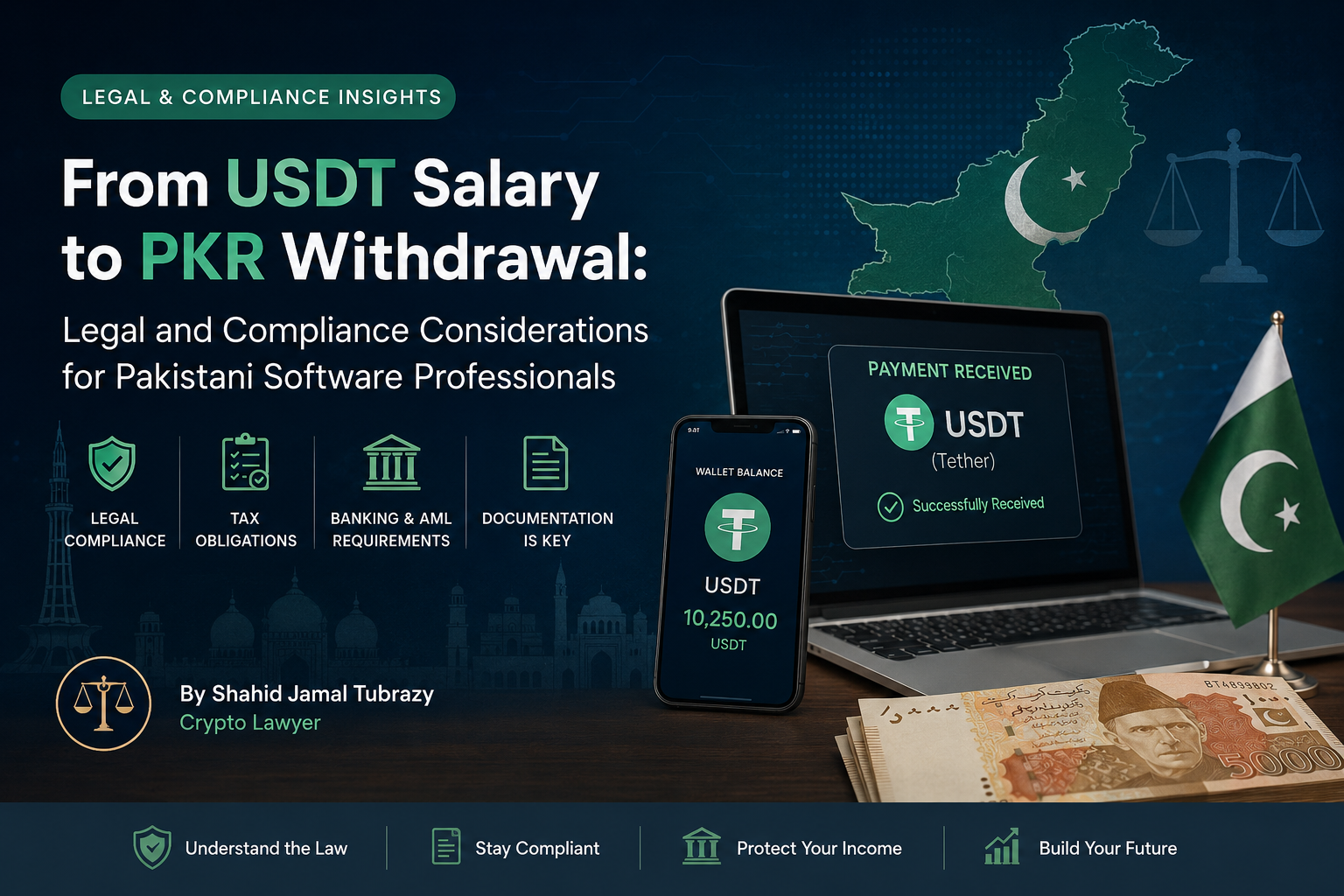
From USDT Salary to PKR Withdrawal: Legal and Compliance Considerations for Pakistani Software Professionals
The global technology industry has transformed how software professionals receive compensation. Increasingly, Pakistani software engineers, blockchain developers, cybersecurity consultants, AI specialists, and remote workers are receiving salaries and consulting fees in stablecoins such as USDT instead of traditional bank transfers.
While receiving compensation in USDT may appear convenient, software professionals must understand the legal, tax, banking, and compliance implications before converting digital assets into Pakistani Rupees (PKR).
As Pakistan moves toward a regulated virtual asset ecosystem under the newly established Pakistan Virtual Assets Regulatory Authority (PVARA) framework, compliance requirements are becoming more important than ever.
Why Employers Are Paying Salaries in USDT
Many international companies prefer USDT because it offers:
- Faster cross-border payments
- Lower transaction costs
- Reduced banking delays
- Access to workers in countries with limited international banking connectivity
- 24/7 settlement capability
For Pakistani software professionals working remotely, USDT often functions as a practical payment mechanism rather than an investment asset.
Is Receiving Salary in USDT Legal in Pakistan?
The legal analysis depends on the nature of the transaction.
Under Pakistan’s emerging virtual asset framework, virtual assets are increasingly recognized as digital assets subject to regulation rather than legal tender. USDT is not considered Pakistani currency, nor does it replace lawful banking channels. However, receiving compensation in a virtual asset is different from using virtual assets as legal tender for domestic transactions.
From a legal perspective, the key issue is whether:
- The source of funds is legitimate.
- The recipient can document the underlying employment or service relationship.
- Applicable tax obligations are satisfied.
- Anti-money laundering (AML) and counter-terrorist financing (CTF) requirements are respected.
Employment Documentation Is Critical
Software professionals receiving USDT should maintain comprehensive records, including:
- Employment contracts
- Consultancy agreements
- Service invoices
- Timesheets
- Client communications
- Wallet transaction records
- Exchange conversion records
- Bank deposit evidence
If questioned by a financial institution or tax authority, documentation demonstrating that USDT originated from legitimate software development services may significantly reduce compliance risks.
AML and Source-of-Funds Requirements
One of the most common compliance mistakes occurs when recipients convert USDT through informal channels without maintaining adequate records.
Banks and financial institutions increasingly examine:
- Source of funds
- Source of wealth
- Transaction purpose
- Beneficial ownership
- Customer due diligence records
Where large or recurring deposits appear inconsistent with a customer’s profile, enhanced due diligence may occur.
Software professionals should be prepared to demonstrate:
- Who paid them
- Why they were paid
- What services were provided
- How the amount was calculated
The burden of proof often falls on the account holder.
Risks Associated with Informal P2P Conversions
Many freelancers convert USDT through peer-to-peer (P2P) transactions.
While P2P markets remain widely used, they can create compliance concerns because the counterparty’s funds may originate from unknown sources. If a transaction becomes linked to fraud, unauthorized payments, money laundering investigations, or financial crime reporting, a recipient’s bank account may face scrutiny. Community discussions in Pakistan frequently highlight concerns regarding account freezes and compliance reviews linked to certain P2P activity.
For this reason, regulated and documented conversion channels generally present lower compliance risk.
Tax Implications for Pakistani Software Professionals
A common misconception is that receiving payment in USDT automatically eliminates tax obligations.
This assumption is incorrect.
Pakistan’s tax system generally focuses on the economic benefit received rather than the payment medium. Crypto-related income, including compensation received in digital assets, may be subject to taxation under existing income tax principles.
Potential tax considerations include:
Scenario 1: Salary Paid in USDT
If a software engineer receives USDT as compensation for employment services, the value of the USDT received may be treated as employment income.
Scenario 2: Freelance or Consulting Income
If a developer receives USDT from foreign clients, the payment may constitute business or professional income.
Scenario 3: Capital Appreciation
If the recipient holds USDT or other crypto assets and later disposes of them at a gain, separate tax consequences may arise depending on future regulatory guidance and applicable tax treatment.
Professional tax advice should be obtained for case-specific situations.
The Importance of Record Keeping
Every software professional receiving digital asset compensation should maintain:
- Wallet addresses
- Blockchain transaction hashes
- Exchange statements
- Screenshots of transfers
- Employer correspondence
- PKR conversion records
- Tax filings
- Banking records
These records may become essential during audits, banking reviews, or regulatory inquiries.
The Future of Crypto Payroll in Pakistan
Pakistan’s regulatory landscape has evolved significantly. The establishment of PVARA and the implementation of the Virtual Assets Act 2026 indicate a shift toward regulated participation rather than outright exclusion of virtual assets from the financial system. Licensed virtual asset businesses are increasingly being integrated into formal banking channels subject to strict compliance requirements.
As the ecosystem matures, software professionals receiving USDT salaries should expect:
- Stronger KYC requirements
- Enhanced transaction monitoring
- Greater tax reporting obligations
- Increased regulatory oversight
- More licensed conversion and custody solutions
Conclusion
Receiving salary in USDT is no longer an unusual arrangement for Pakistani software professionals working in the global digital economy. However, convenience should never replace compliance.
The safest approach is to maintain clear contractual documentation, preserve transaction records, comply with tax obligations, and utilize transparent conversion channels wherever possible.
In today’s regulatory environment, the question is no longer whether virtual assets are visible to regulators. The question is whether the recipient can adequately explain and document every transaction from the moment USDT is received until the funds are withdrawn in PKR.
Disclaimer
The information provided in this article is intended for general informational purposes only and should not be construed as legal or financial advice. Readers are encouraged to seek independent professional counsel tailored to their specific circumstances.
Author & Crypto Consultant
Shahid Jamal Tubrazy – Crypto & Fintech Law Consultant
Shahid Jamal Tubrazy is a recognized professional in the field of cryptocurrency and blockchain law, with specialized certification in Crypto Law from Duke University. As an experienced fintech lawyer, he provides comprehensive legal services across the digital asset ecosystem, including regulatory licensing, legal structuring for ICOs, STOs, DeFi projects, and DAOs.
He also offers expertise in crypto dispute resolution, mediation, negotiation, and mergers & acquisitions within the blockchain sector. With a strong portfolio of published work on blockchain regulation and cryptocurrency law, Shahid delivers practical legal insights to help clients navigate complex regulatory landscapes, ensure compliance, and achieve strategic growth in the evolving fintech industry.
📧 Email: shahidtubrazy@gmail.com
🌐 Website: https://cyberlawconsult.wixsite.com/cryptolawyer
📘 Facebook: https://www.facebook.com/fintechcryptolawyer
🔗 LinkedIn: https://www.linkedin.com/in/tubrazyfintechlawyer/
📝 Blogger: https://sjtubrazylegalpages.blogspot.com/