
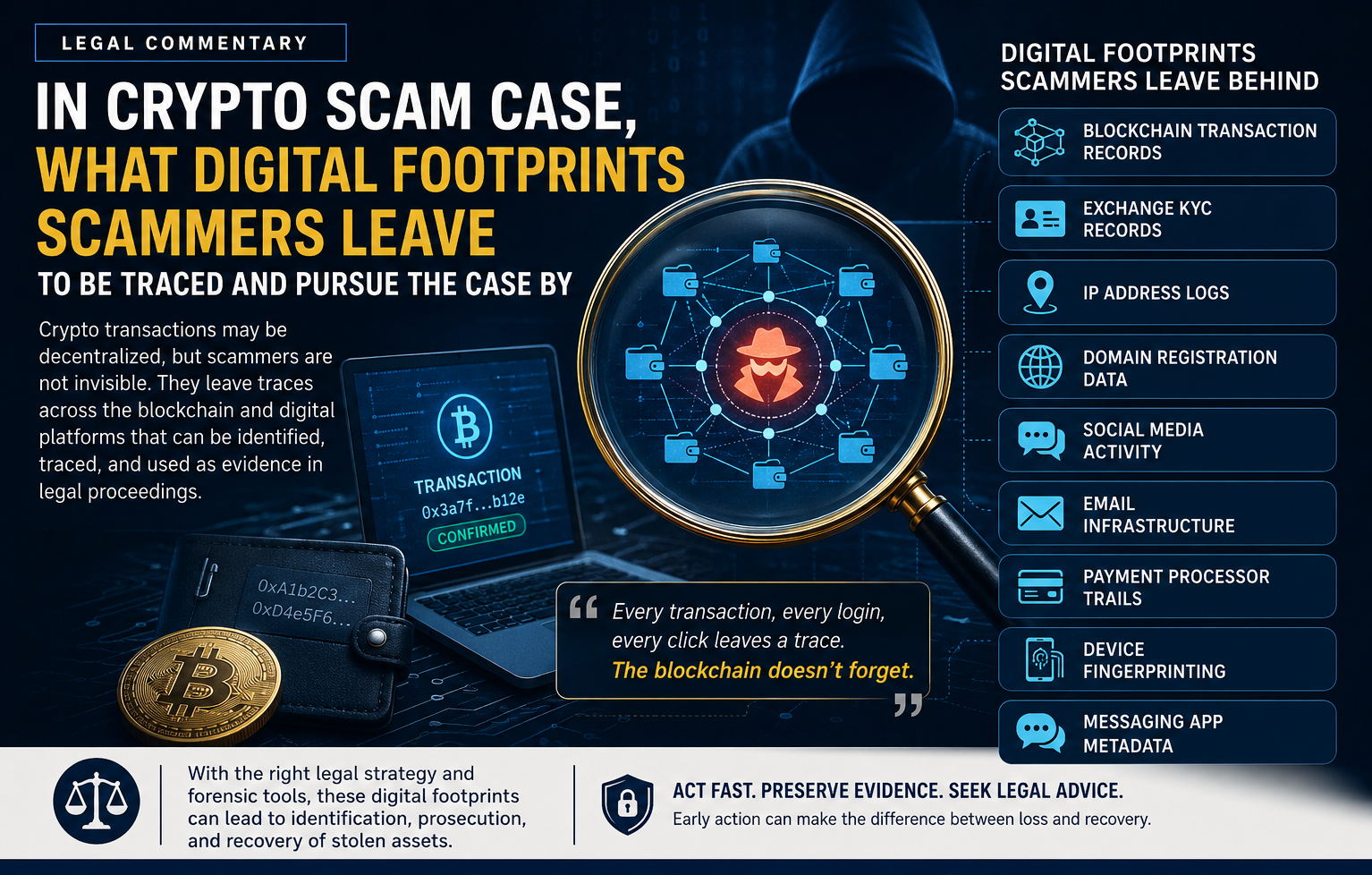
Crypto Scam Investigations: What Digital Footprints Do Scammers Leave Behind?
One of the most common misconceptions among cryptocurrency fraudsters is that blockchain technology guarantees anonymity. In reality, while certain cryptocurrencies provide varying levels of privacy, most crypto transactions create permanent digital records that can be analyzed, correlated, and used as evidence in civil, criminal, and regulatory proceedings.
As a crypto lawyer assisting victims of cryptocurrency fraud, exchange disputes, investment scams, romance scams, pig-butchering schemes, and unauthorized wallet transfers, I have seen countless cases where scammers believed they had successfully hidden their identities. However, digital evidence often tells a very different story.
1. Blockchain Transaction Records
Every transaction recorded on a public blockchain creates an immutable audit trail.
Investigators commonly analyze:
- Wallet addresses
- Transaction hashes
- Deposit and withdrawal patterns
- Cross-chain transfers
- Token swaps
- Bridge activity
- Wallet clustering
Platforms such as the official website of Chainalysis (https://www.chainalysis.com), TRM Labs (https://www.trmlabs.com), and Elliptic (https://www.elliptic.co) provide sophisticated blockchain analytics tools that assist law enforcement agencies and legal professionals worldwide.
Even when criminals move funds through multiple wallets, blockchain tracing can often identify patterns linking addresses to the same operator.
2. Exchange KYC Records
A significant percentage of stolen cryptocurrency eventually reaches centralized exchanges.
When funds enter regulated exchanges, investigators may seek:
- Know Your Customer (KYC) records
- Government identification documents
- Email addresses
- Phone numbers
- IP addresses
- Device identifiers
- Banking information
Major exchanges such as Binance (https://www.binance.com), Coinbase (https://www.coinbase.com), Kraken (https://www.kraken.com), and OKX (https://www.okx.com) maintain compliance systems that may preserve valuable evidence for authorized investigations.
3. IP Address Logs
Scammers frequently access:
- Crypto exchanges
- Trading platforms
- Wallet services
- Email accounts
- Fake investment websites
These services often record:
- Login timestamps
- Device information
- Browser fingerprints
- Geolocation data
- IP addresses
Even when VPN services are used, investigators can sometimes correlate multiple login events and uncover operational mistakes that reveal the true user.
4. Domain Registration Data
Many crypto scams rely upon fraudulent websites.
Digital investigators commonly examine:
- Domain registration records
- Hosting providers
- DNS history
- SSL certificates
- Historical website snapshots
Useful investigative resources include the official services of ICANN Lookup (https://lookup.icann.org), Whois (https://www.whois.com), and SecurityTrails (https://securitytrails.com).
Scammers often reuse email addresses, hosting accounts, or registration information across multiple fraudulent websites.
5. Social Media Evidence
Fraudsters frequently operate through:
- Telegram
- X (formerly Twitter)
Investigators may analyze:
- Usernames
- Profile photographs
- Group memberships
- Contact details
- Historical posts
- Metadata
Many scammers unintentionally reveal personal information through repeated use of the same online identity across different platforms.
6. Email Infrastructure
Email accounts leave extensive forensic evidence.
Important indicators include:
- Header information
- Sending IP addresses
- Recovery email accounts
- Linked devices
- Login records
Even disposable email services can create evidentiary links when combined with blockchain and exchange records.
7. Payment Processor Trails
Many crypto scams involve fiat payments before cryptocurrency transfers occur.
Investigators often trace:
- Credit card transactions
- Bank transfers
- Wire payments
- Payment gateways
- Merchant accounts
Financial institutions are frequently subject to anti-money laundering obligations that require transaction records to be maintained for specified periods.
8. Device Fingerprinting
Modern websites collect substantial technical information.
Investigators may identify:
- Browser signatures
- Operating systems
- Device IDs
- Screen configurations
- Network characteristics
These digital markers can connect multiple accounts to the same individual.
9. Messaging Application Metadata
Even when message contents are unavailable, metadata can be valuable.
Examples include:
- Account creation dates
- Phone numbers
- Login timestamps
- Device identifiers
- Contact relationships
Such information often assists in building a broader evidentiary picture.
10. Money Laundering Patterns
Criminals frequently attempt to conceal stolen assets through:
- Mixers
- Cross-chain bridges
- Decentralized exchanges
- Layered transfers
- Multiple wallets
Ironically, these laundering attempts often create additional records that investigators can analyze.
Legal Perspective: Why Early Action Matters
Time is one of the most important factors in any crypto scam investigation.
Victims should immediately:
- Preserve transaction records.
- Save screenshots and communications.
- Document wallet addresses.
- Report the matter to relevant exchanges.
- Notify law enforcement authorities.
- Obtain blockchain tracing assistance.
- Seek legal advice regarding preservation orders, disclosure requests, freezing remedies, and recovery proceedings.
The longer a victim waits, the greater the chance that evidence may disappear or funds may be moved through additional layers of laundering.
Conclusion
Contrary to popular belief, cryptocurrency scams rarely occur without leaving evidence. Blockchain records, exchange compliance data, IP logs, domain registrations, social media activity, email infrastructure, payment records, and device fingerprints often create a comprehensive trail that can be followed by investigators.
While recovery is never guaranteed, successful crypto investigations frequently begin with the identification and preservation of these digital footprints. The key is acting quickly, securing evidence, and using the appropriate legal and forensic tools before the trail grows cold.
Disclaimer: This article is provided for general informational purposes only and does not constitute legal advice. Individuals affected by cryptocurrency fraud should seek advice tailored to their specific circumstances from a qualified legal professional.
Disclaimer
The information provided in this article is intended for general informational purposes only and should not be construed as legal or financial advice. Readers are encouraged to seek independent professional counsel tailored to their specific circumstances.
Author & Crypto Consultant
Shahid Jamal Tubrazy – Crypto & Fintech Law Consultant
Shahid Jamal Tubrazy is a recognized professional in the field of cryptocurrency and blockchain law, with specialized certification in Crypto Law from Duke University. As an experienced fintech lawyer, he provides comprehensive legal services across the digital asset ecosystem, including regulatory licensing, legal structuring for ICOs, STOs, DeFi projects, and DAOs.
He also offers expertise in crypto dispute resolution, mediation, negotiation, and mergers & acquisitions within the blockchain sector. With a strong portfolio of published work on blockchain regulation and cryptocurrency law, Shahid delivers practical legal insights to help clients navigate complex regulatory landscapes, ensure compliance, and achieve strategic growth in the evolving fintech industry.
📧 Email: shahidtubrazy@gmail.com
🌐 Website: https://cyberlawconsult.wixsite.com/cryptolawyer
📘 Facebook: https://www.facebook.com/fintechcryptolawyer
🔗 LinkedIn: https://www.linkedin.com/in/tubrazyfintechlawyer/
📝 Blogger: https://sjtubrazylegalpages.blogspot.com/