The Ultimate Crypto Scam Recovery Guide: How to Recover Stolen Cryptocurrency and Report Bitcoin Fraud
The cryptocurrency industry has revolutionized finance, creating unprecedented opportunities for investment, decentralized finance (DeFi), tokenization, and cross-border payments. However, with this rapid growth has come a dramatic increase in cryptocurrency scams, blockchain fraud, phishing attacks, fake investment platforms, romance scams, wallet thefts, and sophisticated cyber-enabled financial crimes.
Having worked extensively with cryptocurrency scam victims since 2018, I have witnessed the devastating financial and emotional consequences these scams inflict on individuals and businesses across the world. Every year, thousands of investors lose Bitcoin, Ethereum, USDT, and other digital assets to organized criminal networks operating across multiple jurisdictions.
Throughout my professional experience as a cryptocurrency lawyer, I repeatedly noticed one disturbing pattern—most victims simply do not know what to do after discovering they have been scammed.
Instead of preserving evidence, they unknowingly delete valuable communications.
Instead of reporting immediately, they wait for weeks or months.
Instead of consulting qualified professionals, they become victims of another fraud—commonly known as a crypto recovery scam.
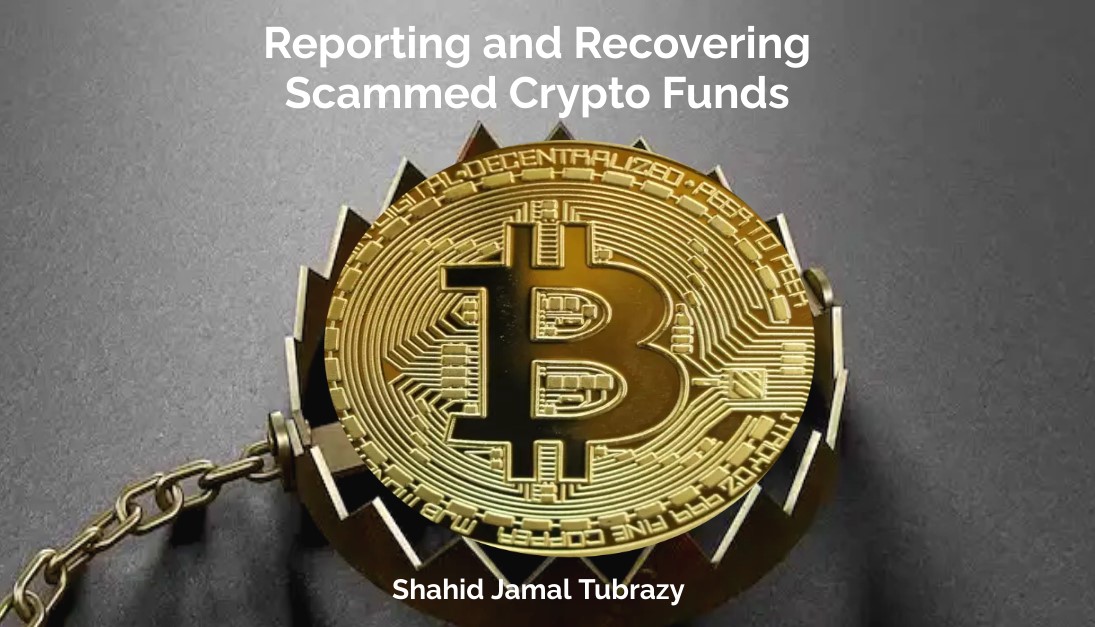
It was this recurring problem that inspired me to write “Reporting and Recovering Scammed Crypto Funds: A Comprehensive Guide.” This book is not merely another publication about cryptocurrency. It is a practical handbook written from real-world experience to help victims understand what actions should be taken immediately after a cryptocurrency fraud.
A Book Written from Practical Experience
Unlike many books that focus only on blockchain technology or cryptocurrency investing, this guide has been written from years of practical exposure to actual cryptocurrency scam cases.
Since 2018, I have dealt with matters involving:
- Fake cryptocurrency exchanges
- Investment fraud
- Pig-butchering scams
- Romance scams
- Wallet compromise
- Fake ICOs
- NFT fraud
- DeFi scams
- Exchange-related disputes
- Blockchain tracing
- Crypto compliance investigations
- Cross-border cryptocurrency fraud
Rather than relying solely on theory, this book combines legal knowledge with practical investigative procedures that victims can understand and follow.
Why Every Crypto Scam Victim Needs This Guide
One of the biggest misconceptions surrounding cryptocurrency fraud is that victims believe they have unlimited time to act.
Unfortunately, blockchain transactions move extremely quickly.
Within hours, stolen assets may pass through multiple wallets, decentralized exchanges, blockchain bridges, mixers, or privacy coins, making investigations increasingly complex.
That is why the book emphasizes taking immediate action, including:
- Preserving digital evidence
- Recording blockchain transaction hashes
- Securing remaining digital assets
- Reporting incidents to cryptocurrency exchanges
- Filing complaints with relevant authorities
- Understanding available legal remedies
Readers will also learn why maintaining proper documentation significantly improves the effectiveness of any future legal or investigative process.
Understanding Blockchain Investigations
One of the greatest strengths of blockchain technology is transparency.
Every Bitcoin, Ethereum, or other blockchain transaction creates a permanent public record.
Modern blockchain investigation companies such as Chainalysis (https://www.chainalysis.com), TRM Labs (https://www.trmlabs.com), and various blockchain intelligence platforms assist investigators in analyzing transaction flows, identifying exchange wallets, and supporting financial crime investigations.
Although blockchain analysis alone cannot guarantee recovery, it plays a critical role in identifying transaction paths and preserving investigative evidence.
Cryptocurrency Recovery Is Never Guaranteed
The internet is full of advertisements claiming:
“Guaranteed Crypto Recovery”
“100% Recovery in 24 Hours”
“Hackers Will Recover Your Crypto”
Victims should be extremely cautious.
Legitimate cryptocurrency recovery does not consist of “hacking back” stolen wallets.
Instead, legitimate recovery usually involves a combination of:
- Blockchain forensic analysis
- Digital evidence preservation
- Legal documentation
- Exchange cooperation
- Regulatory reporting
- Cybercrime investigations
- International legal cooperation
Anyone promising guaranteed recovery without reviewing the facts should be approached with caution.
Learning from International Best Practices
The cryptocurrency industry is global.
A victim may reside in Canada, while the scammer operates from Southeast Asia using wallets hosted by exchanges in another jurisdiction.
For this reason, the book discusses the importance of international cooperation between law enforcement agencies and regulatory authorities.
Readers are encouraged to become familiar with organizations such as:
- The Financial Action Task Force (FATF) – https://www.fatf-gafi.org
- INTERPOL – https://www.interpol.int
- Europol European Cybercrime Centre – https://www.europol.europa.eu
- The FBI Internet Crime Complaint Center (IC3) – https://www.ic3.gov
- The U.S. Department of Justice – https://www.justice.gov
- The U.S. Securities and Exchange Commission (SEC) – https://www.sec.gov
- The U.S. Commodity Futures Trading Commission (CFTC) – https://www.cftc.gov
- FinCEN – https://www.fincen.gov
These organizations regularly publish guidance relating to cryptocurrency fraud, cybercrime investigations, anti-money laundering (AML), and financial crime prevention.
The Importance of Cybersecurity
Recovering from a cryptocurrency scam also requires strengthening digital security.
Government agencies such as the Cybersecurity and Infrastructure Security Agency (CISA) provide valuable recommendations on protecting cryptocurrency users from phishing attacks, malware, ransomware, and identity theft.
Useful cybersecurity guidance is available :
Likewise, cybersecurity standards published by the National Institute of Standards and Technology (NIST) can help organizations and professionals improve digital security practices:
Who Should Read This Book?
This guide has been written for:
- Cryptocurrency investors
- Bitcoin holders
- Blockchain professionals
- Cryptocurrency lawyers
- Compliance officers
- AML specialists
- Financial crime investigators
- Cybersecurity professionals
- Blockchain analysts
- Law enforcement officers
- Digital asset businesses
- Crypto exchanges
- Web3 entrepreneurs
Whether you have already become a victim of cryptocurrency fraud or simply wish to understand how investigations work, this book provides practical guidance developed from years of professional experience.
Why I Decided to Write This Book
After handling cryptocurrency scam matters since 2018, I realized there was a significant gap between technical blockchain knowledge and practical guidance available to ordinary victims.
Most books discuss cryptocurrencies from an investment perspective.
Very few explain:
- What should be done immediately after discovering a scam.
- How blockchain evidence should be preserved.
- Which authorities should be notified.
- How exchanges may assist investigations.
- What legal remedies may be available.
- How victims can avoid becoming victims twice through fake recovery companies.
This book was written to bridge that gap.
It aims to educate, inform, and empower cryptocurrency users through practical knowledge rather than unrealistic promises.
The ultimate objective is not to promise guaranteed recovery—it is to help victims make informed decisions, protect their legal rights, preserve critical evidence, and understand the recovery process with realistic expectations.
In an industry evolving as rapidly as cryptocurrency, knowledge remains the most valuable asset. By understanding how scams operate, how blockchain investigations work, and how legal and regulatory processes function, victims are better equipped to protect themselves and contribute to the fight against cryptocurrency fraud.
For readers seeking additional information on blockchain security, cryptocurrency regulation, cybercrime prevention, and financial crime investigations, authoritative resources from Chainalysis, TRM Labs, FATF, INTERPOL, IC3, SEC, CFTC, FinCEN, CISA, and NIST provide valuable guidance that complements the principles discussed throughout this book.
Disclaimer
The information provided in this article is intended for general informational purposes only and should not be construed as legal or financial advice. Readers are encouraged to seek independent professional counsel tailored to their specific circumstances.
Author & Crypto Consultant
Shahid Jamal Tubrazy – Crypto & Fintech Law Consultant
Shahid Jamal Tubrazy is a recognized professional in the field of cryptocurrency and blockchain law, with specialized certification in Crypto Law from Duke University. As an experienced fintech lawyer, he provides comprehensive legal services across the digital asset ecosystem, including regulatory licensing, legal structuring for ICOs, STOs, DeFi projects, and DAOs.
He also offers expertise in crypto dispute resolution, mediation, negotiation, and mergers & acquisitions within the blockchain sector. With a strong portfolio of published work on blockchain regulation and cryptocurrency law, Shahid delivers practical legal insights to help clients navigate complex regulatory landscapes, ensure compliance, and achieve strategic growth in the evolving fintech industry.
📧 Email: shahidtubrazy@gmail.com
🌐 Website: https://cyberlawconsult.wixsite.com/cryptolawyer
📘 Facebook: https://www.facebook.com/fintechcryptolawyer
🔗 LinkedIn: https://www.linkedin.com/in/tubrazyfintechlawyer/
📝 Blogger: https://sjtubrazylegalpages.blogspot.com/